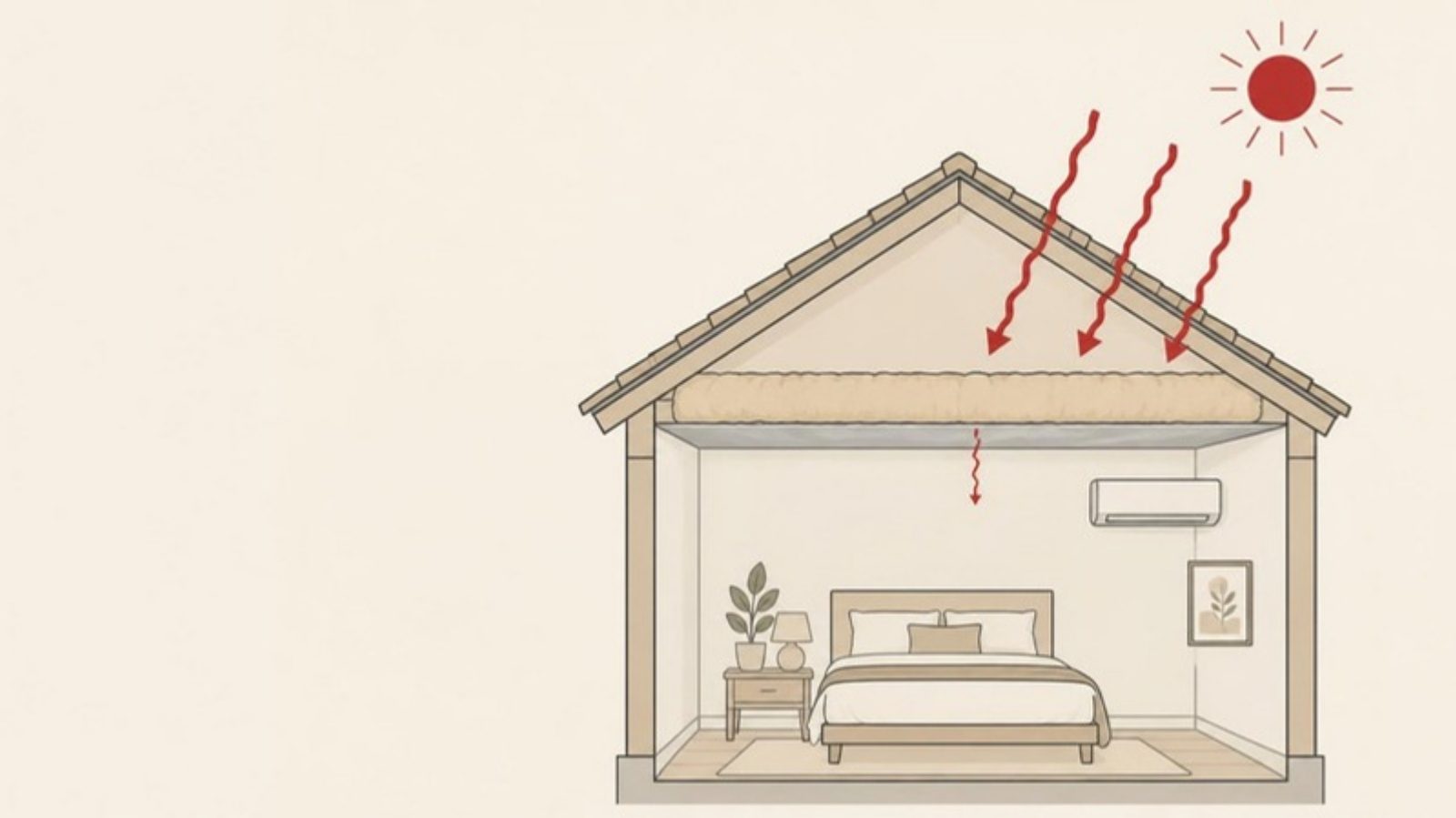
In shortAn air-conditioner uses electricity to move heat that has entered the room back outside. Insulation on the ceiling or under the roof reduces the part of that heat coming through the roof, so the air-conditioner has less load and the compressor runs for less time. How many percent you save depends on what share of the building's heat comes from the roof, how much insulation was there already, how well it is installed and how the air-conditioning is used. There is no single figure that can be promised for every building.
What heat is the air-conditioner fighting?
The heat an air-conditioner must remove is called the cooling load. It arrives by several routes at once:
- Roof and ceiling — the sun makes the roof very hot, and the heat passes down to the ceiling and into the room.
- Windows and glazing — sunlight comes straight through. In heavily glazed buildings this can be the main load.
- Walls, especially those facing the afternoon sun — see hot west-facing walls.
- Air leakage and ventilation — hot, humid outside air that comes in must be cooled and dried.
- Heat generated in the room — people, lights, appliances, cooking.
Roof and ceiling insulation reduces only the first item. See the overview in how heat enters buildings.
How insulation reduces the load
Heat always flows from hot to cold. How much passes through the ceiling depends on the temperature difference between the roof space and the room, and on the thermal resistance of the layers in between. Insulation adds resistance, measured as R-value. The higher the total R, the more slowly heat gets through.
A Thai study of test houses with metal-sheet roofs compared houses with insulation under the roof against one without. The insulated houses had less heat passing through the ceiling and a cooler roof space than the reference house. The result belongs to those test houses, but it confirms the direction of the principle.
Two effects are noticeable: the air-conditioner uses less electricity at the same set temperature, and the ceiling surface is cooler, so the room feels more comfortable at the same air temperature. In a building without air-conditioning, insulation does not cut the electricity bill, but it reduces the heat radiating down onto people.
What decides whether savings are large or small
- The roof's share of the heat — a single-storey house or a top-floor room under the roof gains a lot; a lower-floor room with another room above gains little.
- Existing insulation — a ceiling with no insulation shows the clearest effect. Adding more on top of an already thick layer gives progressively smaller gains, because there is less heat left to stop.
- The R-value actually achieved after installation — gaps, open joints and crushed insulation reduce the result. See gaps and compression and thermal bridges.
- Ducts and equipment in the roof space — if air-conditioning ducts run through a hot roof space, heat enters the ducts as well. See why ducts are insulated.
- Windows, walls and air leaks — if another route is the main one, it has to be dealt with too.
- The air-conditioner and how it is used — unit efficiency, set temperature, hours of operation, and whether it runs by day or by night.
- Climate and roof colour — strong sun and a dark roof increase the heat from the roof, so insulation has more to do.
Why a single percentage cannot be promised
The Florida Solar Energy Center explains, writing about radiant barriers, that total savings are capped by the share of the load that comes through the ceiling. The same logic applies to any insulation. Take a hypothetical example:
- If heat from the roof is 30% of the cooling load and insulation halves it, the total cooling load falls by about 15%.
- If heat from the roof is only 10%, the same halving reduces the total load by about 5%.
These numbers are arithmetic to illustrate the point, not a prediction for any house. The same insulation therefore affects the electricity bill very differently from one house to another. Percentages in advertising or product documents are results under one set of test conditions or assumptions; always ask what it was compared with, where it was measured and what was included.
The reliable ways are to have an engineer or energy auditor calculate that building's cooling load, or to compare electricity use and air-conditioner running hours before and after installation during periods of similar weather and use.
Choosing insulation that pays off
- Houses with a ceiling — lay foil-wrapped roll insulation on the ceiling without opening the roof, for example glass wool SCG STAY COOL, 75 mm (insulation R-value 1.79 m²·K/W according to the manufacturer) with a 150 mm version also available, or stone wool ROCKWOOL Rock Chill, 75 mm. See ceiling insulation.
- Factories, warehouses and metal-roofed buildings without a ceiling — fit insulation under the roof sheet, such as fully foil-encapsulated glass wool SCG SUPER COOL-G. See metal roof insulation.
- Compare insulation by R-value at the thickness that will actually be installed, not by a percentage. See insulation thickness.
- Combine it with shading the windows, sealing air leaks and maintaining the air-conditioner, so the overall effect is clearer.
Sources
- Florida Solar Energy Center (FSEC) — Radiant Barriers: A Question and Answer Primer (savings capped by the ceiling's share of load; smaller where existing insulation is thick)
- Building Science Corporation — BSD-011: Thermal Control in Buildings (components of cooling load)
- U.S. Department of Energy, Energy Saver — Consumer Guide to Home Landscaping (solar heat through windows and roofs adds to air-conditioner load)
- ROCKWOOL — Cool 'n' Comfort Blanket and Slab Data Sheet
- SCG — SCG Thermal Insulation for Roof brochure
- Journal of Industrial Technology, Suan Sunandha Rajabhat University, Vol. 11 No. 1 (2023) — Thermal performance of thermal insulation installed under metal sheet roofs
Related products
Categories and example products for this topic
- SCG STAY COOL — Foil-wrapped glass wool laid on ceilings, 75 and 150 mm (R 1.79 m²·K/W at 75 mm)
- ROCKWOOL Rock Chill — Fully foil-wrapped stone wool roll for house ceilings, 75 mm, 2.4 m² per roll
- SCG SUPER COOL-G — Foil-encapsulated glass wool for under the metal roofs of large buildings
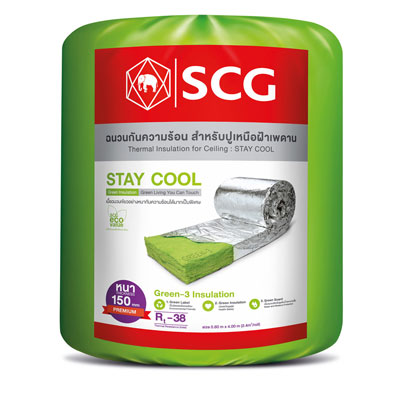
Building thermal insulation · Glass wool
- Thickness
- 75–150 mm
- Thermal resistance (R)
- 1.79 m²·K/W (75 mm)
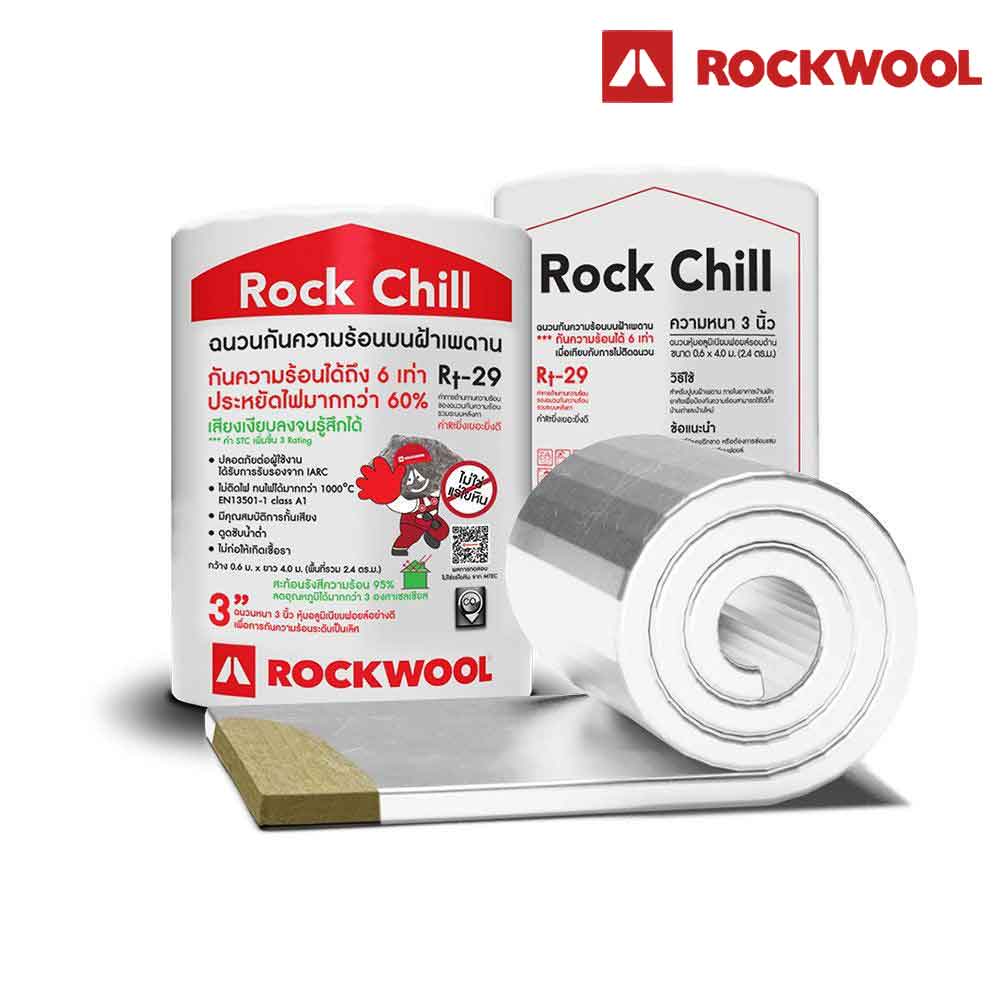
Building thermal insulation · Stone wool
- Thickness
- 75 mm
- Width
- 600 mm
- Length
- 4,000 mm
Building thermal insulation · Glass wool
- Thickness
- 25–75 mm
- Density
- 12–24 kg/m³
- Thermal conductivity (λ)
- 0.035–0.042 W/m·K
Read next