What is mineral fibre board, and how does it absorb sound?
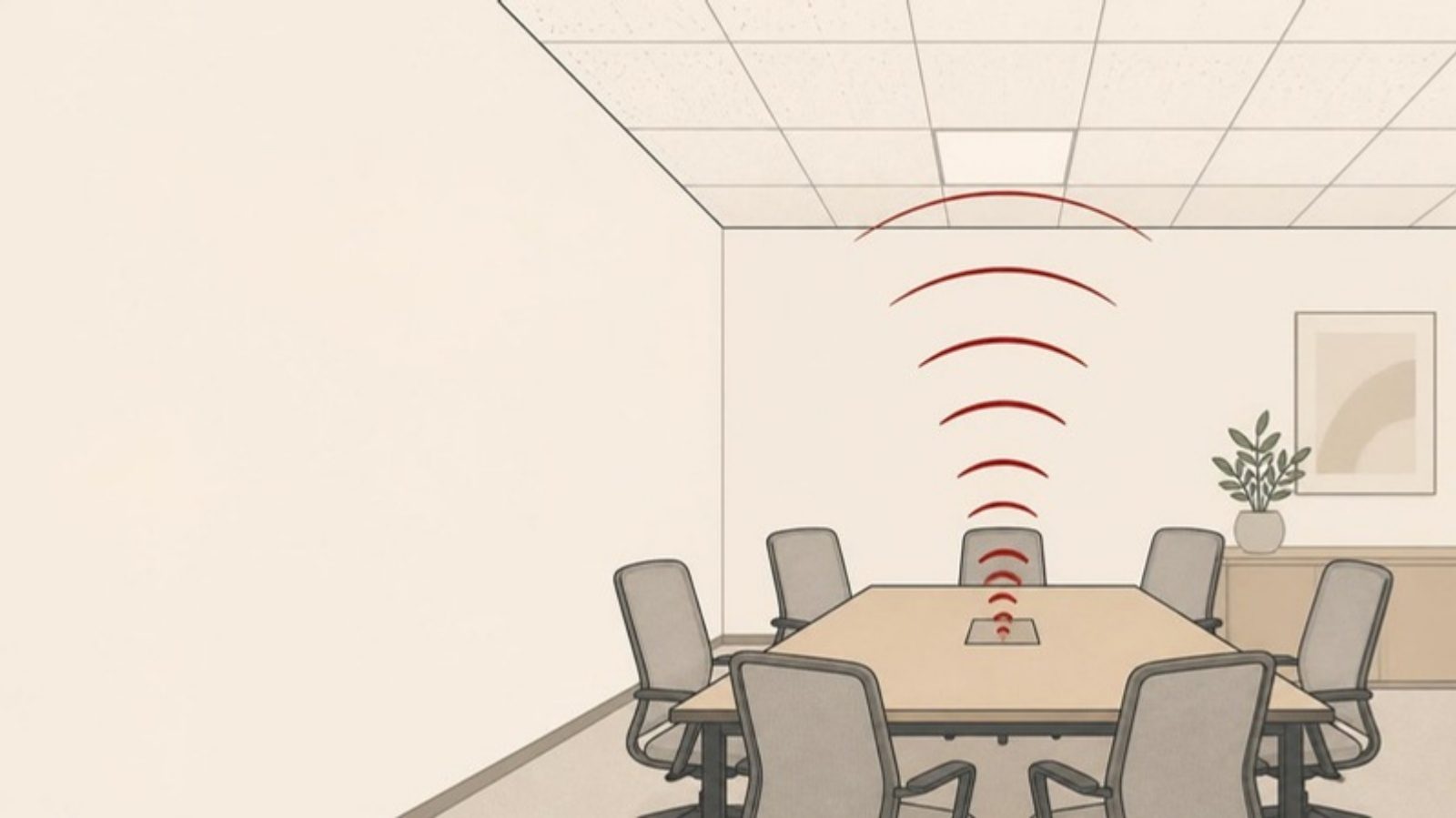
Mineral fibre board (mineral fibre ceiling tile) is a porous board formed from mineral fibres mixed with fillers and a binder. It is used as a ceiling tile or wall board to absorb sound and reduce echo inside a room: sound enters the small pores in the face and body of the board and loses energy there. Two things to know: this type of board does not like high humidity, and painting over it usually reduces its absorption. Absorption values belong to each product and mounting method, not to "mineral fibre board" in general.
What is it made of?
Recipes differ between manufacturers, but in general terms the board contains:
- Mineral wool fibres, which form the skeleton of the board
- Lightweight fillers such as perlite, which helps give the board its porosity, and clay
- A binder, commonly starch
- In some products, a share of recycled material
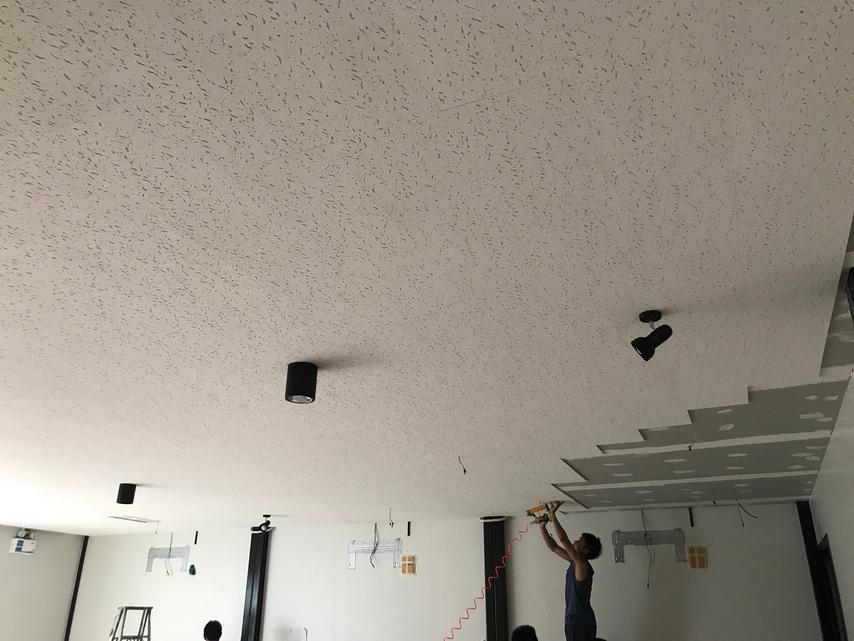
The mix is formed into a rigid board, the face is given small holes or fissures, and a factory paint finish is applied. The board is stiff enough to sit in a ceiling grid or to be glued in place — unlike soft glass-wool or stone-wool rolls, which need a covering.
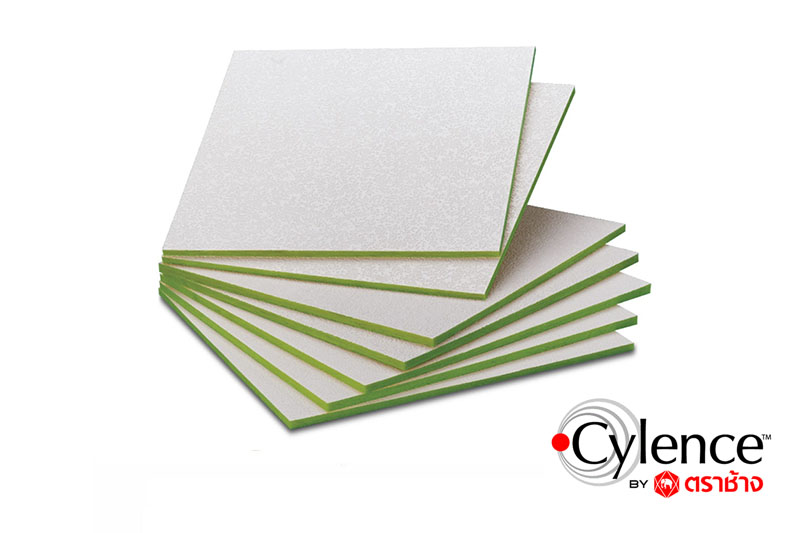
"Acoustic ceiling" covers several materials. Some tiles are rigid pressed mineral fibre; others are faced glass-wool tiles, such as SCG Cylence Armax, a glass-wool ceiling tile with a white vinyl face and aluminium foil backing that lays into a T-bar grid. Both are used to reduce echo, but the core material, weight and care differ. See how to choose acoustic ceiling tiles.
How does it absorb sound?
Mineral fibre board is a porous absorber. When a sound wave reaches it, air moves in and out of the pores and the gaps between fibres. Friction in those tiny passages turns part of the sound energy into a very small amount of heat, so less sound is reflected back into the room.
What affects absorption:
- The face must be open. Holes, fissures or a porous finish are how sound gets into the board
- Thickness and density. Thin boards absorb treble and speech frequencies better than bass
- Mounting. The same board hung with an air space behind it and glued flat to a hard surface gives different test results
The figures used for comparison are the NRC and the sound absorption coefficient, which must always be read together with the thickness and mounting used in the test.
What does humidity do?
Boards that rely on a binder such as starch soften when exposed to high humidity for long periods. The usual signs are sagging, staining or mould. A major mineral-fibre ceiling manufacturer therefore recommends humidity-resistant grades for spaces with high or seasonal humidity, and advises against use in continuously wet areas such as shower rooms or indoor pools.
Good practice:
- Fix onto dry surfaces with no leaks from the roof or pipes
- Fix leaks and condensation first; do not use the boards to cover them up
- Ask the seller what humidity range the product tolerates if the room is not air-conditioned all the time or is near a kitchen or bathroom
Can it be painted?
Physically yes, but do not expect the same absorption afterwards. Ordinary paint bridges the pores in the face, so less sound gets into the board. Some manufacturers also state that repainting may affect fire test results, sag resistance and the warranty.
An example from our own measurement: M-Board, a 300 × 600 × 12 mm mineral-fibre board, measured NRC 0.53 unpainted — a reverberation-time measurement in a test room by Get Best Sound, not a manufacturer report — and in the same measurement a painted board absorbed less (about 0.39). If you need a different room colour, choose a board with a factory finish or talk to us before painting.
Where is it used?
| Form | Installation | Suits |
|---|---|---|
| --- | --- | --- |
| Lay-in ceiling tile | Sits in a T-bar grid; removable | Offices, classrooms, shops, corridors |
| Glue-on board | Glued to an existing smooth ceiling or wall | Rooms that already have a flat ceiling and need more absorbing area |
The rooms that benefit most are those where speech echoes until it is hard to follow, such as meeting rooms, classrooms and restaurants. M-Board is the glue-on type for an existing smooth ceiling or wall, so the ceiling does not have to be removed or a new grid built. How many boards a room needs depends on its size and existing surfaces; see echo and reverberation time.
Limits to understand
- Absorbing boards reduce echo inside the room; they do not stop sound passing through a wall or ceiling to the next room. See soundproofing vs sound absorption
- One product's NRC cannot stand in for another's, even if both are "mineral fibre"
- Fire information must come from the test documents for the specific product. If your project has fire requirements, ask for the documents before ordering
Sources
- Armstrong World Industries — Frequently Asked Questions (mineral-fibre ceiling ingredients, humidity, painting, cleaning)
- The Construction Specifier — Customize acoustic ceilings with specialty coatings (effect of paint on pores and absorption)
- SCG International — SCG Armax Acoustic Ceiling Tile (product page)
- GetBestInsulations — verified product data for M-Board (reverberation-time measurement by Get Best Sound, Dec 2024) and SCG Cylence Armax
Related products
Categories and example products for this topic
- M-Board — 12 mm mineral-fibre board glued to smooth surfaces; NRC 0.53 (our test, unpainted)
- SCG Cylence Armax — Glass-wool ceiling tile, white vinyl face, foil back, 19/25 mm, for T-bar grids