Echoey meeting room with unclear speech: absorb at the ceiling or the walls?
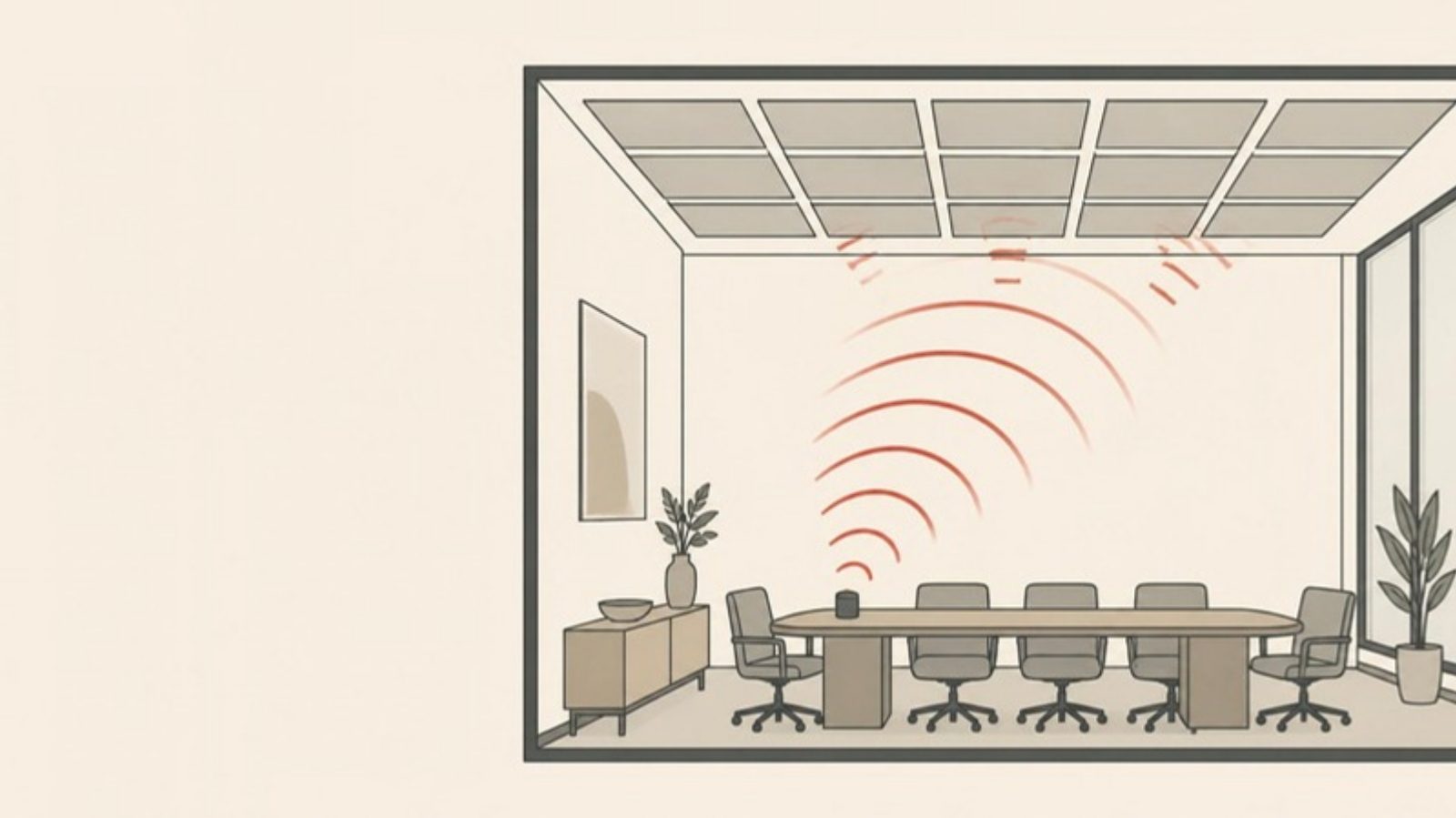
In an ordinary rectangular meeting room, start with the ceiling: it is a large, free surface where absorption can be spread across the room. Add the rear wall or a side wall when the ceiling cannot supply enough absorption or reflections between walls remain. The key question is not only "where" but "how much absorption area does this room need to gain" — which is calculated from the room size and a target reverberation time (RT), and should be checked by measuring before and after.
Why is speech hard to follow?
Typical symptoms in a meeting room:
- Speech seems to hang in the room; new words overlap old ones
- When several people talk at once, nothing can be followed
- People at the far end cannot hear clearly
- Remote participants say the room sounds echoey and tiring
- Turning the loudspeakers up makes it harder, not easier
The main cause is usually not that speech is too quiet, but that reflections stay in the room too long. Meeting rooms tend to have hard, smooth floors, walls, glass and ceilings, so sound bounces many times before it dies away. Turning up the loudspeakers raises the direct sound and the reflections together, so it rarely helps.
The quantity used here is reverberation time (RT) — see Reverberation and reverberation time. Note that a lower RT is not always better: an over-absorbed room sounds dead, the talker is quieter for people further away, and material is wasted.
What RT should a meeting room have?
The target depends on room size and use. Published examples:
- WELL Building Standard (Feature 78 Reverberation Time) sets conference rooms at an RT of 0.6 seconds, verified by an on-site test
- DIN 18041 (the German standard for acoustic quality in rooms) places meeting and seminar rooms with several talkers in a communication usage group; the target varies with room volume, and rooms used for video conferencing fall in a group that calls for a lower RT
If the project has its own requirement, follow it — and look at each frequency band, not just a room that is fine in the treble but still booms in the bass.
Why the ceiling is usually the main surface
Reducing RT depends on the total absorption area in the room; nothing says the material must be on a wall. Most meeting rooms are low but wide and long, so the ceiling is usually larger than any one wall, while the walls are already taken by screens, whiteboards, cabinets or glass. Using the ceiling as the main absorbing surface:
- leaves the walls free and does not interfere with screens or boards
- lets the material be spread across the whole room
- keeps it out of reach of hands, chairs and knocks
A ceiling alone does not fix every room
Ceiling absorbers work well on sound travelling up into them, but much less on sound travelling parallel to the ceiling and floor. If the walls are hard and parallel, that sound keeps bouncing between them. In rooms where almost all absorption is on the ceiling, the measured RT is therefore often longer than Sabine's formula predicts. Furniture and other objects help by scattering some of the sound up towards the ceiling.
When should the walls be treated too?
Consider adding wall absorption when:
- the calculation shows the ceiling area cannot supply enough absorption
- a hand clap produces a rapid rattling repeat (flutter echo) between parallel hard walls
- the rear wall throws sound back to the talker or the microphones — common in long rooms and video-conference rooms
- the room is long, large or high
- services, lights or diffusers leave too little free ceiling
So the position of the material should follow what the room needs — not walls out of habit, and not avoiding walls to save money.
How much: a first estimate
A first estimate uses Sabine's relationship:
RT ≈ 0.16 × V ÷ A
- V = room volume (m³)
- A = total absorption area (m²) = the sum of each surface's area × its sound absorption coefficient
With a target RT you can work back to the total absorption area the room needs, subtract what it already has, and find how much to add. Cautions:
- NRC is an average over 250–2000 Hz and is fine for a rough estimate. Real design should use absorption coefficients per frequency; thin boards usually absorb less in the bass than their average suggests
- Absorption depends on mounting. Values measured flat against a surface and with an air space behind are not the same; use the value that matches how you will install
- Allow a margin when almost all absorption is on the ceiling, for the reason given in the warning above
Worked example (hypothetical room)
The numbers in this example are made up to show the method only. They are not values for any real room or product.
A meeting room 6 m wide, 8 m long and 2.8 m high, with a tiled floor, plastered walls and a smooth plasterboard ceiling (48 m² of ceiling).
| Step | Value |
|---|---|
| --- | --- |
| Room volume V | 6 × 8 × 2.8 = 134.4 m³ |
| Existing absorption (assumed) | about 12 m² |
| Estimated RT now | 0.16 × 134.4 ÷ 12 ≈ 1.8 s |
| Target RT | 0.6 s |
| Absorption area needed | 0.16 × 134.4 ÷ 0.6 ≈ 36 m² |
| To be added | about 24 m² |
Each square metre of material fixed over the old ceiling adds (the material's coefficient − the old ceiling's coefficient). Assume the old ceiling is about 0.05:
| Material's absorption coefficient (assumed) | Material area required | Against 48 m² of ceiling |
|---|---|---|
| --- | --- | --- |
| 0.5 | 24 ÷ 0.45 ≈ 53 m² | The ceiling alone is not enough; walls are needed too |
| 0.7 | 24 ÷ 0.65 ≈ 37 m² | About three quarters of the ceiling |
| 0.9 | 24 ÷ 0.85 ≈ 28 m² | About six tenths of the ceiling |
The example shows that the amount of material can be calculated rather than guessed, and that in the same room a different material can change the answer from "the ceiling is enough" to "walls are needed as well". There is therefore no ready-made rule that a room of a certain height is solved by covering the ceiling. For a real job, have an engineer calculate band by band with values from the material's test report.
Which materials?
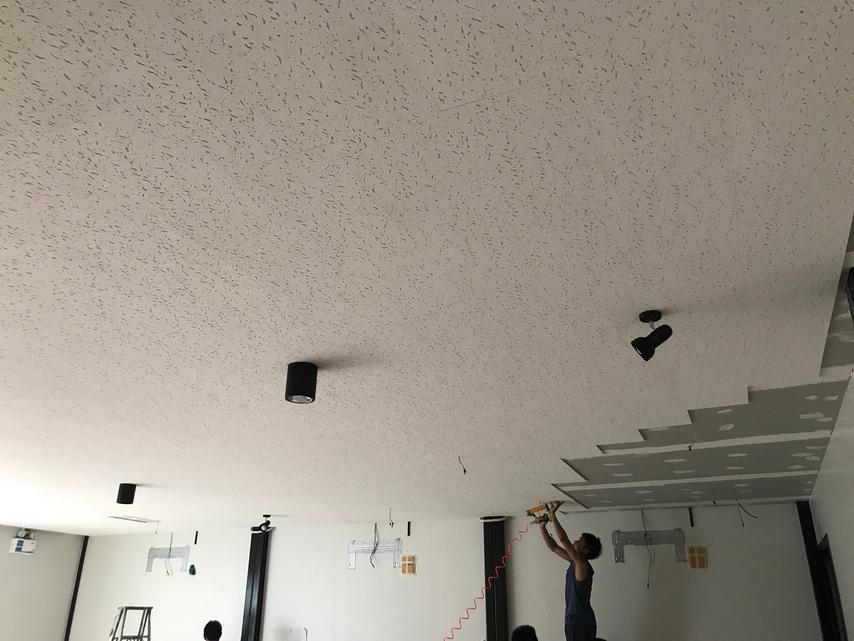
- Existing smooth ceiling you do not want to remove — a glue-on absorbing board fixed over the old ceiling, such as M-Board, a mineral-fibre board 300 × 600 mm, 12 mm thick. Its NRC of 0.53 is a Get Best Sound measurement on an unpainted board, not a manufacturer report; do not paint it, because painting reduces absorption. Fix onto dry surfaces with no leaks
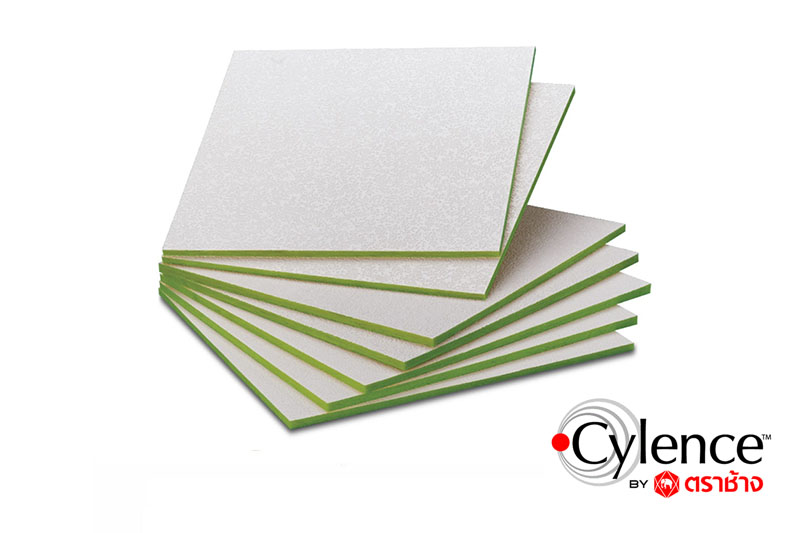
- T-bar grid ceiling — swap the tiles for sound-absorbing ceiling tiles such as SCG Cylence Armax, a glass-wool tile with a white vinyl face, 19 and 25 mm thick. See Choosing a sound-absorbing ceiling
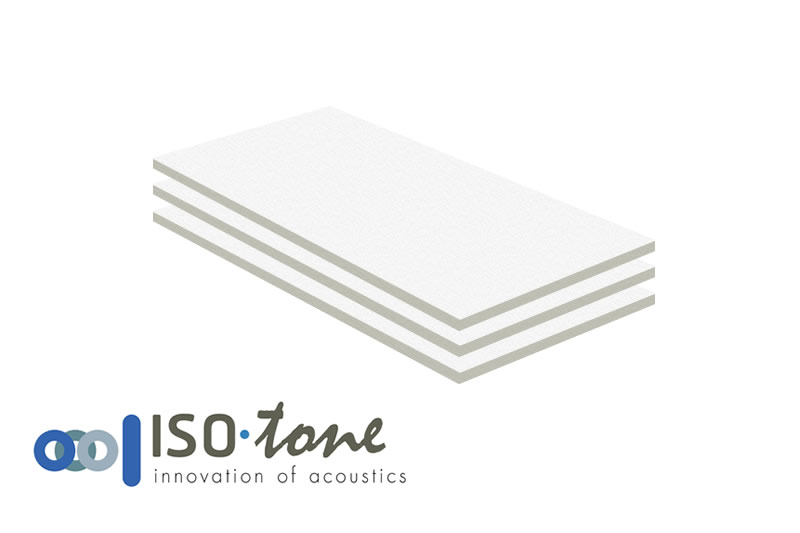
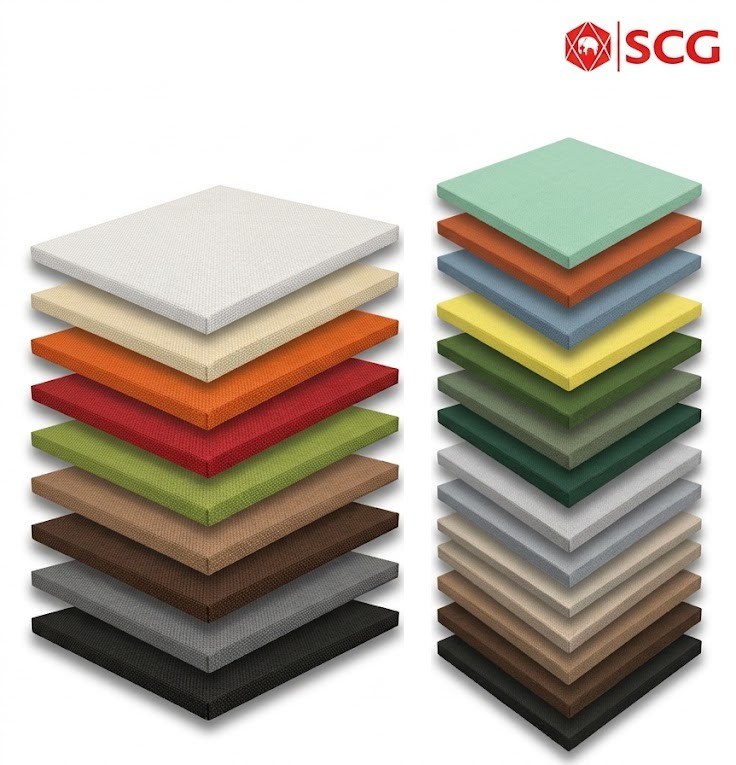
- Rear or side walls — fabric-wrapped wall panels such as SCG Cylence Zandera (25 mm glass wool, NRC 0.75 to ASTM C423; the document does not state the test mounting), or the polyester-fibre board ISO TONE, 25 or 50 mm thick, which can be wrapped in decorative fabric or placed behind perforated panels
For the fire behaviour of interior finishes, check each product's documents against the project's requirements.
Measure before and after
A calculation is an estimate; real rooms differ in furniture, glass and shape. Measuring RT before and after installation to ISO 3382-2 confirms whether the room has reached its target and shows whether wall absorption should be added.
Less reverberation is not sound insulation
Absorbers make sound inside the room clearer, but they do not keep the meeting from being heard next door. See Do sound absorbing panels stop noise leaving a room?
See solution: Echoey rooms
Sources
- WELL Building Standard v1 — Feature 78 Reverberation Time (conference rooms 0.6 s, on-site performance test)
- DIN 18041:2016 Acoustic quality in rooms — cited via papers by C. Nocke (ICA 2016, Euronoise 2018)
- Ecophon (Saint-Gobain) — Rooms with absorbent ceilings: limits of rooms where absorption is on the ceiling
- ASTM C423 — measurement of sound absorption in a reverberation room and definition of NRC (summary by Intertek)
- ISO 3382-2 — Measurement of room acoustic parameters — Reverberation time in ordinary rooms
- Product documents: SCG Cylence Zandera installation guide, ISO TONE data sheet, SCG Armax product page, M-Board measurement by Get Best Sound
Related products
Categories and example products for this topic
- M-Board — Mineral-fibre board glued onto the existing smooth ceiling — no ceiling removal.
- SCG Cylence Armax — White-vinyl-faced glass-wool tile, 19/25 mm, for rooms with a T-bar grid ceiling.
- ISO TONE — Polyester board, 25/50 mm, for walls — fabric-wrapped or behind perforated panels.
- SCG Cylence Zandera — 25 mm fabric-wrapped glass-wool panel in 9 colours for a finished rear wall.
Sound absorption · Polyester fibre
ISO NOISE ISO TONE
- Thickness
- 25–50 mm
- Sound absorption (NRC)
- 0.69–0.86
Sound absorption · Glass wool
SCG Cylence Zandera
- Thickness
- 25 mm
- Density
- 100 kg/m³
- Sound absorption (NRC)
- 0.75