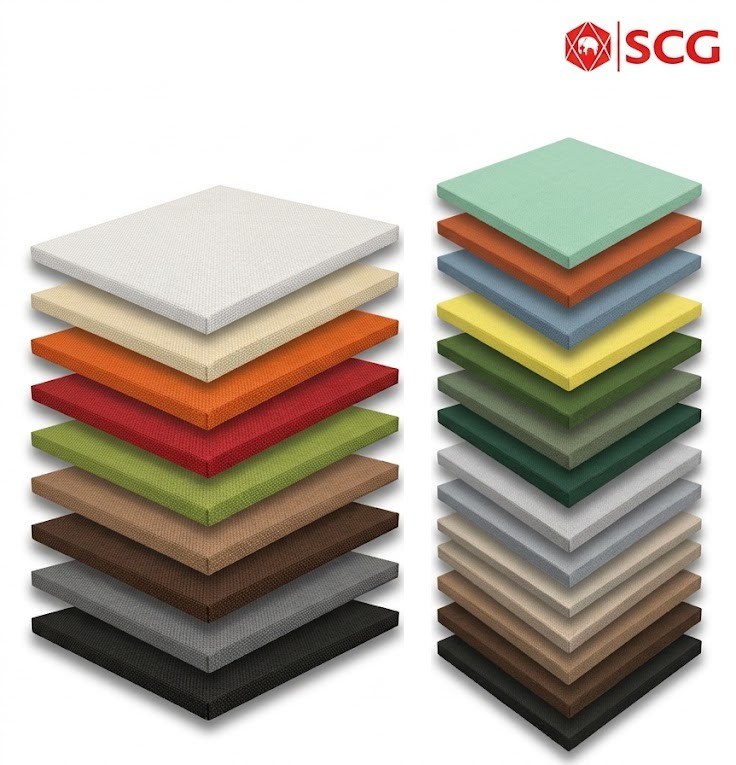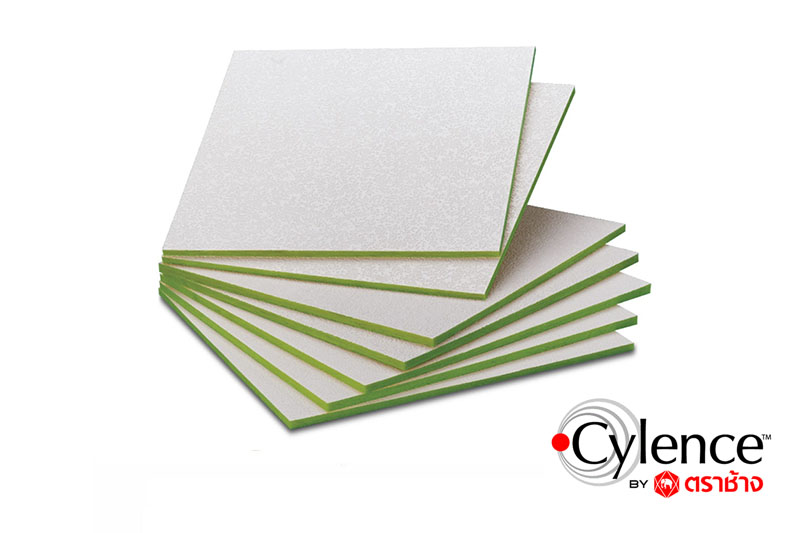
Sound absorption · Glass wool
SCG Cylence Zoftone
- Thickness
- 25–50 mm
- Density
- 32–64 kg/m³
- Sound absorption (NRC)
- up to 1.00
Sound coming in or going out (sound insulation)
Echoey rooms (sound absorption)
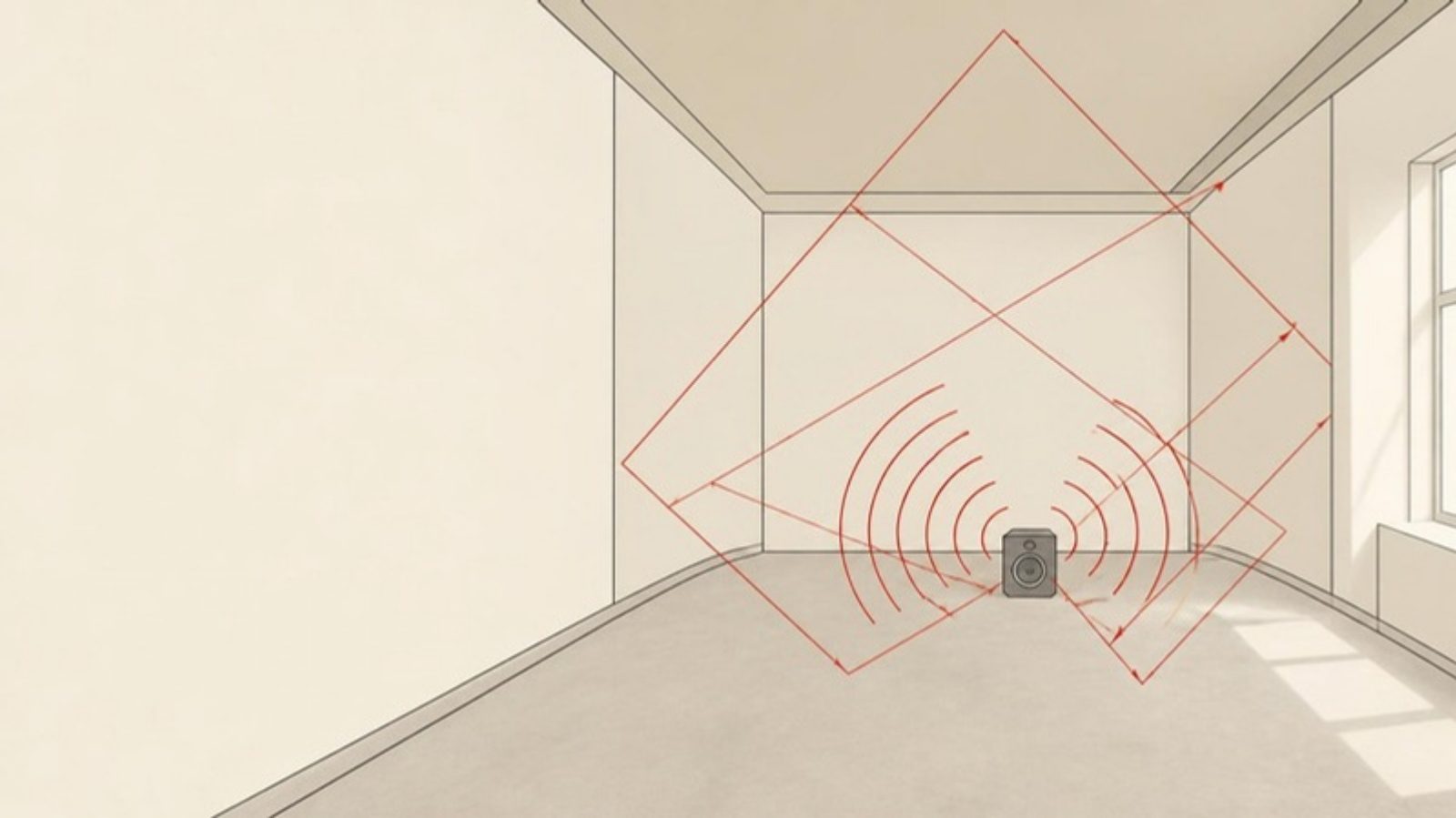
Reverberation is the mass of reflections from walls, ceiling and floor that overlap so the sound lingers in the room after the source has stopped. Reverberation time (RT or RT60) is the time it takes for the sound level in the room to fall by 60 dB after the source stops. Large rooms with hard surfaces have a long RT; rooms with plenty of absorption have a short RT.
In everyday Thai all of this is called "ห้องก้อง" (an echoey room), but the fix can differ slightly depending on what you hear.
Reverberation increases when:
RT is the time in seconds for the level to drop 60 dB after the source stops. In practice, measurements to ISO 3382-2 usually take a 20 dB or 30 dB portion of the decay and extrapolate to 60 dB (called T20 and T30), and they are made per frequency band, because a room can be more reverberant in the bass than in the treble.
When reading a report, check which frequency bands were used and which bands any single summary figure averages.
Sabine's formula estimates RT well in rooms where absorption is spread fairly evenly:
RT ≈ 0.16 × V ÷ A
What it tells you: a bigger room has a longer RT, and doubling the total absorption area roughly halves the RT. So both the absorption of the material and the area installed matter, not just the figure on the datasheet.
Sabine's formula suits a first estimate. For unusual room shapes, absorption concentrated on one surface, or when accuracy matters, have an acoustic consultant calculate or measure.
The right value depends on the use and size of the room. Rooms for clear speech, such as classrooms and meeting rooms, usually need a shorter RT than rooms for some kinds of music. One published example is the US classroom standard ANSI/ASA S12.60, which sets a maximum RT of 0.6 seconds for unoccupied, furnished classrooms up to about 283 m³, and 0.7 seconds for classrooms of about 283–566 m³.
These figures are criteria for classrooms under that standard, not a value for every room. If your project has its own requirement, follow it.
Reducing RT makes sound inside the room clearer, but it does not stop sound passing through the walls to other rooms. See Do sound absorbing panels stop noise leaving a room?
See solution: Echoey rooms
Categories and example products for this topic
Sound absorption · Glass wool
Sound absorption · Glass wool
Check the message below, then press “Open LINE”. On a phone LINE opens with this message; on a computer LINE shows a QR code to scan with your phone. If LINE does not open, copy the message into the chat, or call us.
Add us on LINE: @x2525 · Call 062-195-1909