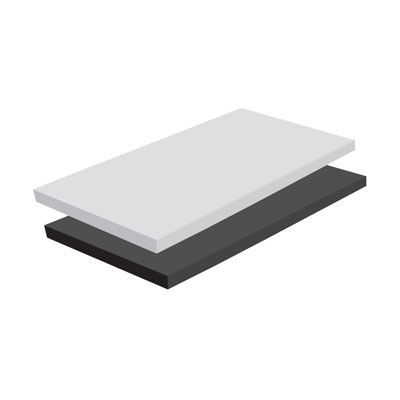
Sound absorption · Polyester fibre
ISO NOISE ISO TONE
- Thickness
- 25–50 mm
- Sound absorption (NRC)
- 0.69–0.86
Sound coming in or going out (sound insulation)
Echoey rooms (sound absorption)
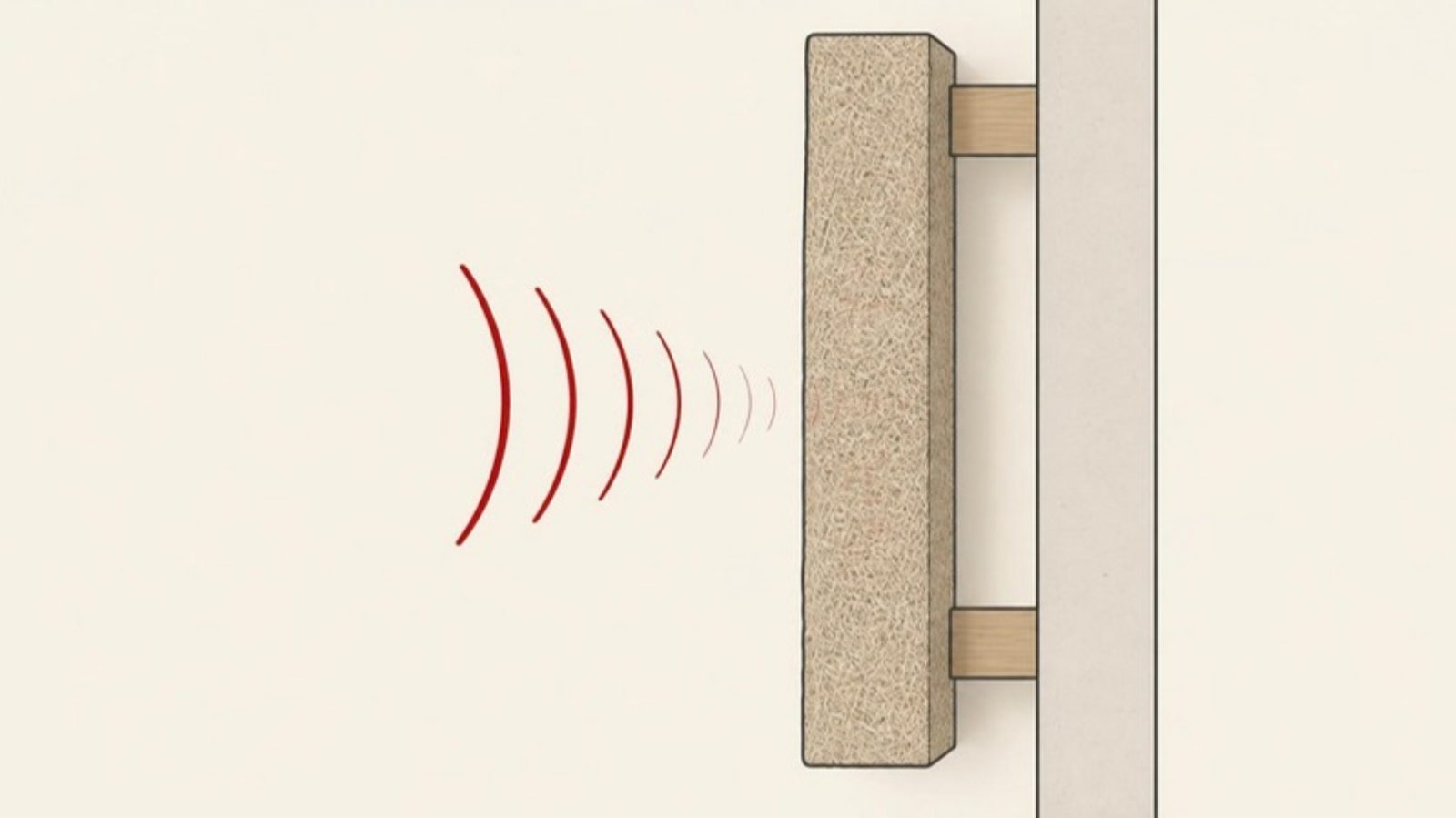
The sound absorption coefficient (α) is the share of the sound energy striking a surface that is not reflected back into the room: 0 means everything is reflected, 1 means everything is absorbed. One material has different α values at different frequencies, so it is reported as a table by frequency. NRC, SAA and αw are single numbers worked out from that table in different ways. For porous materials α also depends on thickness and on the air space behind, especially at low frequencies.
Most values in manufacturers' documents are measured in a reverberation room to ISO 354 or ASTM C423. The laboratory measures how fast sound dies away in the room before and after the specimen is placed; the added absorption divided by the specimen area gives α for each frequency band.
The result is therefore a value for that specimen at that thickness, facing and mounting, not a fixed property of the raw material.
A manufacturer's table may show values such as 1.05 or 1.15. That does not mean the material absorbs more than 100% of the sound. ASTM C423 explains that diffraction at the edges of the specimen makes it appear larger than its real area, so measured values for highly absorptive specimens can exceed 1 — and the standard warns that these values should be used with caution, because installed areas are usually larger than the test specimen and the sound field in a real room differs from the laboratory.
| Value | Standard | Worked out from | Note |
|---|---|---|---|
| --- | --- | --- | --- |
| α per frequency | ISO 354 / ASTM C423 | The measured value in each frequency band | The fullest information; used for band-by-band calculation |
| NRC | ASTM C423 | Average of α at 250, 500, 1000 and 2000 Hz, rounded to the nearest 0.05 | Leaves out 125 Hz and 4000 Hz |
| SAA | ASTM C423 | Average of the one-third-octave bands from 200 to 2500 Hz, rounded to the nearest 0.01 | Finer than NRC, but covers a similar range |
| αw | ISO 11654 | Octave-band values (αp) from 250 to 4000 Hz compared with a reference curve | May carry a letter L, M or H, and is grouped into classes A–E |
Good to know:
For more on NRC see What is NRC.
Porous materials — glass wool, stone wool, polyester fibre, open-cell foam — absorb sound through friction as air moves through the pores. But at a hard wall the air hardly moves; the movement is greatest about a quarter of a wavelength away from the wall.
A 1000 Hz sound has a wavelength of about 34 cm, while 125 Hz is about 2.7 m. A 25 mm board fixed flat to a wall therefore sits where the air moves enough for treble, but for bass the whole board is still where the air is almost at rest.
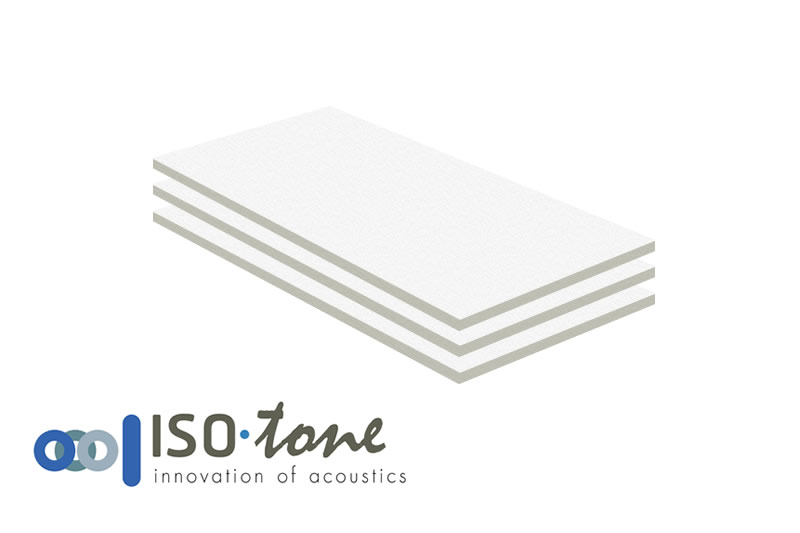
An example from the data sheet of ISO TONE polyester-fibre board (ASTM C423; the document does not state the test mounting):
| Thickness | 125 Hz | 250 Hz | 500 Hz | 1000 Hz | 2000 Hz | 4000 Hz | NRC |
|---|---|---|---|---|---|---|---|
| --- | --- | --- | --- | --- | --- | --- | --- |
| 25 mm | 0.04 | 0.28 | 0.68 | 0.89 | 0.90 | 0.82 | 0.69 |
| 50 mm | 0.15 | 0.75 | 0.89 | 0.93 | 0.86 | 0.89 | 0.86 |
From 1000 Hz upwards the two thicknesses are close, but at 250 Hz the 50 mm board absorbs more than two and a half times as much as the 25 mm board — and at 125 Hz both still absorb little.
Fixing the board away from the wall or the old ceiling — on a frame, or as a suspended ceiling — puts the material where the air moves more, so low-frequency absorption improves without extra thickness.
That is why α for the same board differs with the test mounting. ASTM E795 defines the arrangements, such as Type A (laid directly on the surface) and E-400 (board face 400 mm from the surface), while documents in the ISO system usually state the overall depth of the construction or the suspension depth. For the effect on ceiling tiles see Choosing a sound-absorbing ceiling.
A reading example: 50 mm Zoftone grade M has 0.80 / 1.15 / 1.05 / 0.93 at 250 / 500 / 1000 / 2000 Hz, an average of about 0.98, which rounds in 0.05 steps to the NRC of 1.00 given in the document.
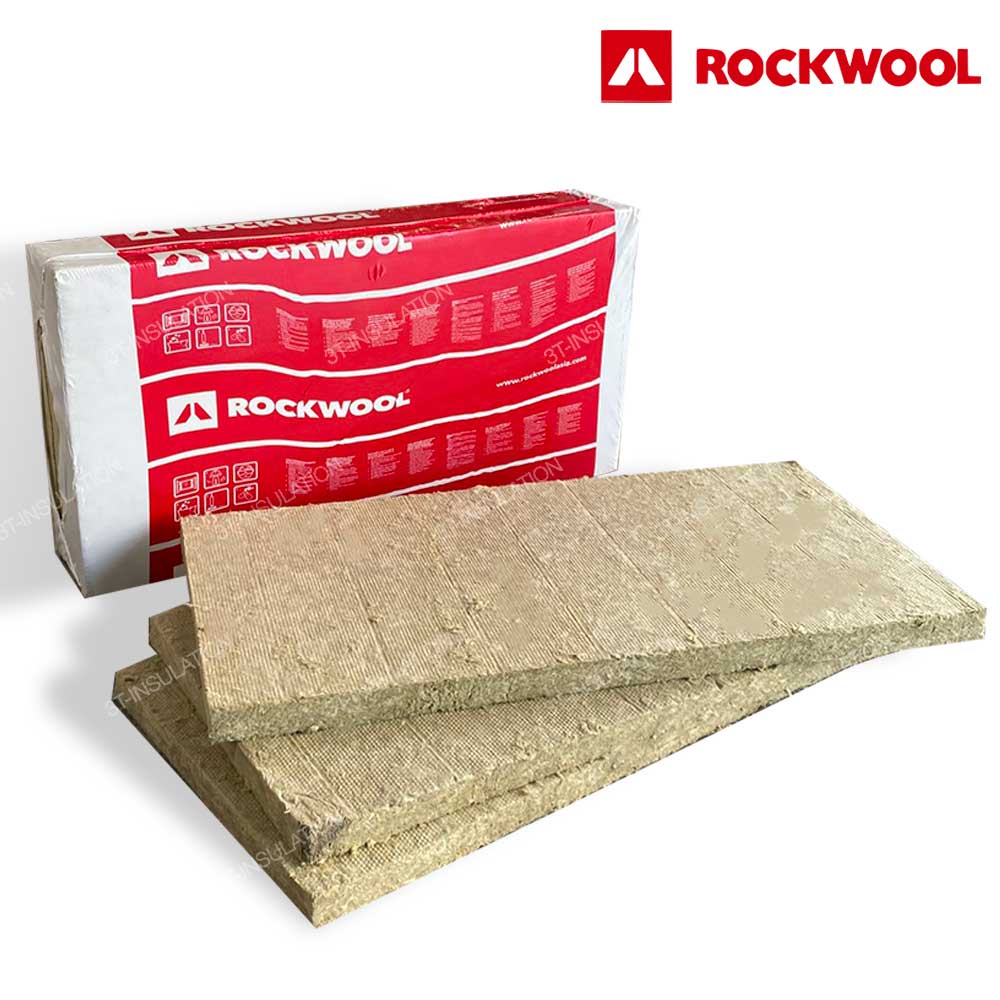
General-purpose stone wool also carries absorption values. ROCKWOOL Thermalrock S, for instance, states NRC 0.90–1.05 depending on the density grade (ISO 354). These are values for the bare slab; behind perforated panels or fabric the overall result also depends on the facing.
The absorption area of a surface equals area × α. Adding up every surface in the room gives the total absorption area, which is used to estimate reverberation time with Sabine's formula — see the example in Echoey meeting rooms and Reverberation and reverberation time.
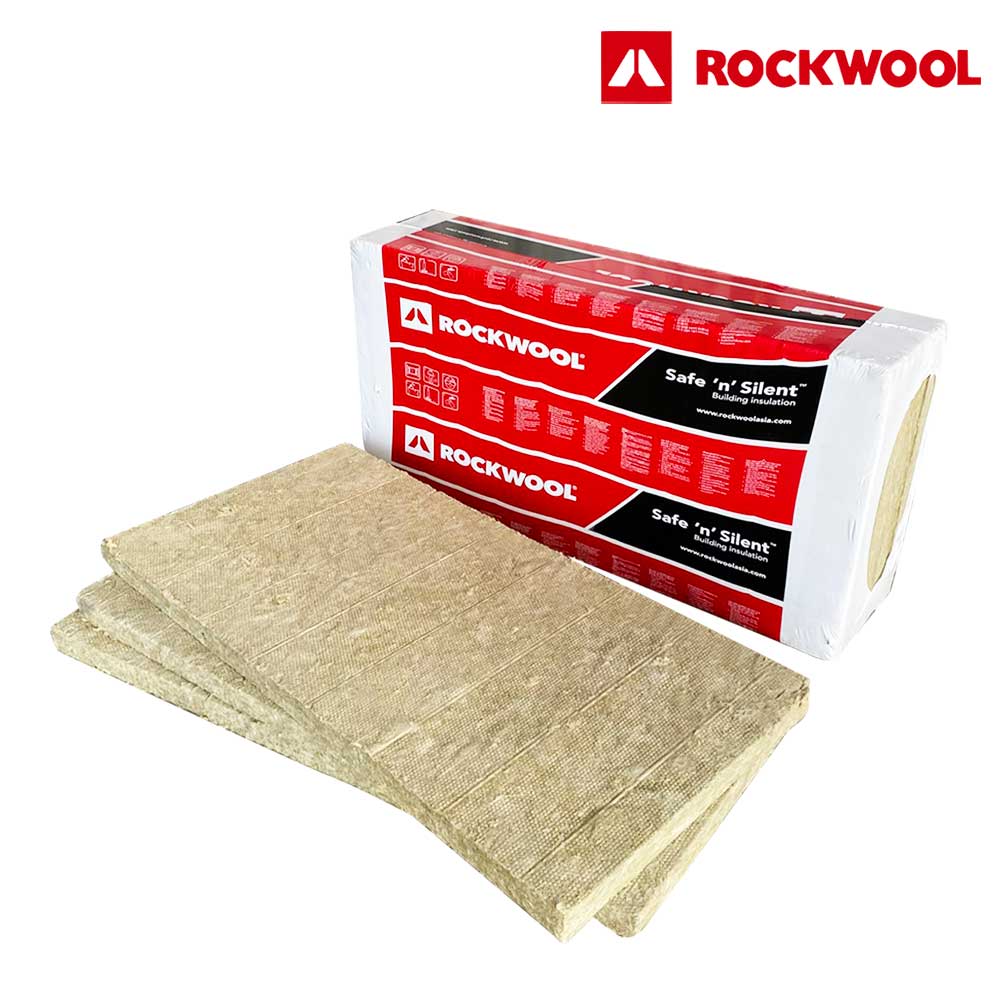
α and NRC say how little sound a surface reflects back into the room; they do not say how much sound passes through to the other side. Insulation with a high NRC, such as ROCKWOOL Safe 'n' Silent Pro (NRC 0.90–1.00 at 50 mm), is fitted in wall cavities as one part of a sound-insulating wall system. The STC or Rw rating belongs to the complete wall system, not to the insulation alone. See STC and Rw.
Categories and example products for this topic
Sound absorption · Polyester fibre
Sound absorption · Glass wool
Building thermal insulation · Stone wool
Sound insulation · Stone wool
Check the message below, then press “Open LINE”. On a phone LINE opens with this message; on a computer LINE shows a QR code to scan with your phone. If LINE does not open, copy the message into the chat, or call us.
Add us on LINE: @x2525 · Call 062-195-1909