Choosing a sound-absorbing ceiling: T-bar tiles or boards glued onto the existing ceiling?
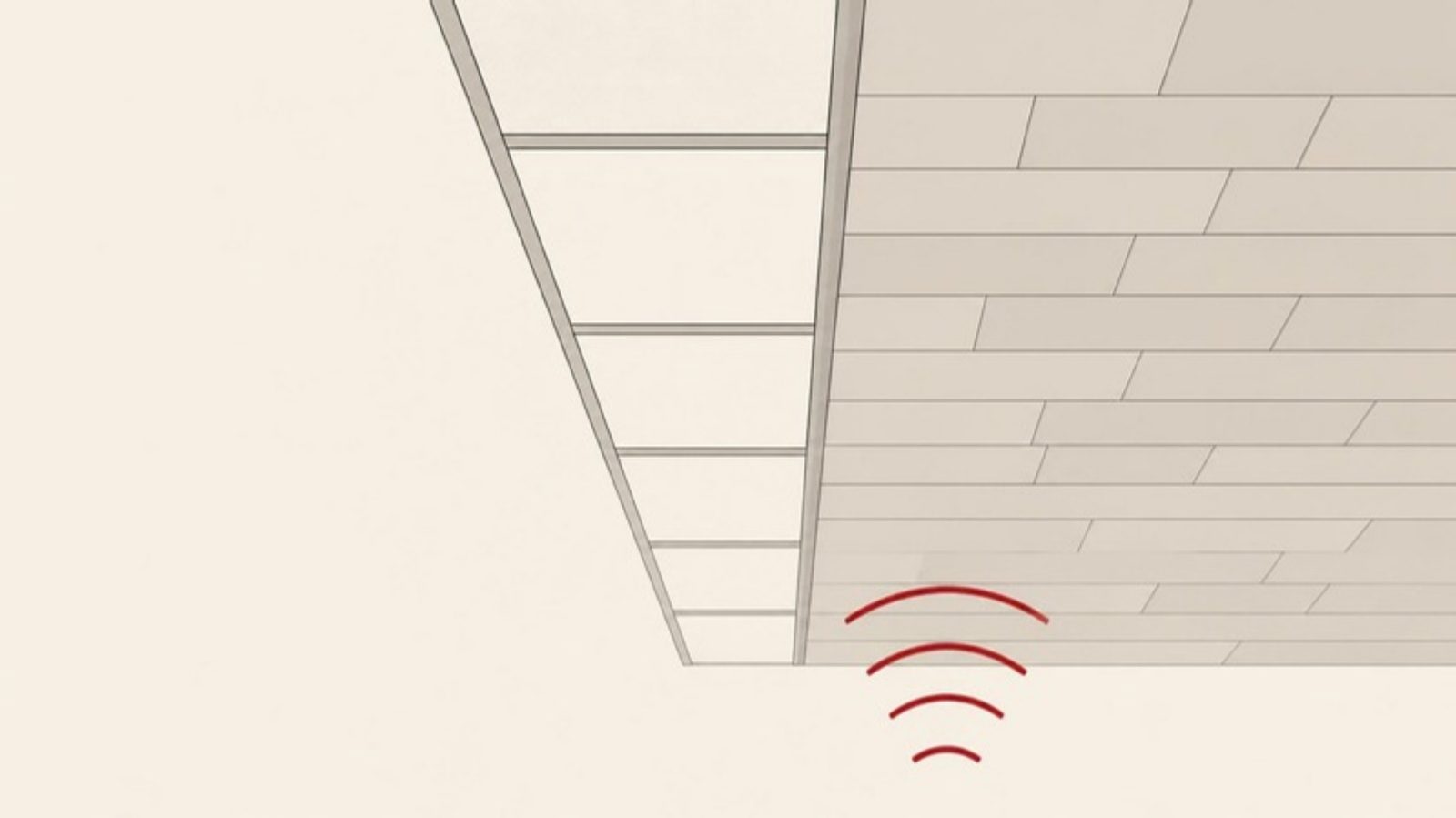
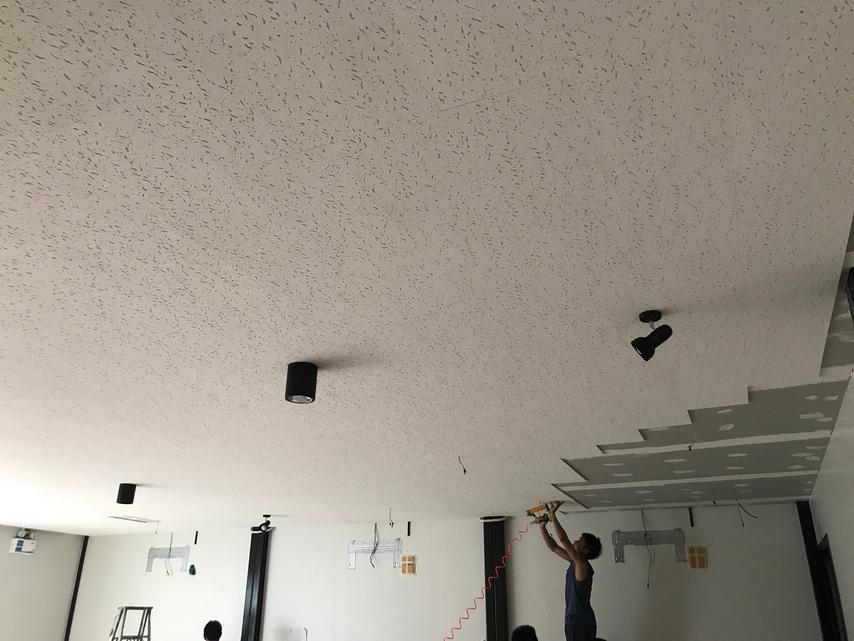
If the room already has a T-bar grid, or a new ceiling is being built, use lay-in sound-absorbing ceiling tiles; the air space above the ceiling helps low-frequency absorption. If the room has a smooth plastered ceiling you do not want to remove, use absorbing boards glued onto the existing ceiling — quick to install and with almost no loss of height. When comparing NRC values, check which test mounting was used, and do not forget humidity, cleaning and the fire documents for the product.
How do the two routes differ?
| Consideration | Absorbing tiles on a T-bar grid | Absorbing boards glued onto a smooth ceiling |
|---|---|---|
| --- | --- | --- |
| Suits | Rooms with an existing grid, or new ceilings | Rooms with an existing smooth plasterboard or other flat ceiling |
| Work involved | Swap the tiles, or hang a new grid | Apply adhesive and fix over; no removal |
| Room height | A new ceiling needs a void above it | Height lost equals the board thickness |
| Air space behind | Yes (the ceiling void) | Almost none; the board sits on the old surface |
| Access to services above | Tiles lift out | Same as the old ceiling |
| Appearance | A visible grid | Visible board joints; the laying pattern can be chosen |
Neither suits every room. The deciding factors are what ceiling is already there and how much absorption the room needs.
What does the NRC on a ceiling tile tell you?
NRC (Noise Reduction Coefficient) is the average of the absorption coefficients at 250, 500, 1000 and 2000 Hz from an ASTM C423 test, rounded to the nearest 0.05. It is a good first comparison, but three things need reading alongside it — see What is NRC.
1. The test mounting. ASTM E795 defines how specimens are mounted. Ceiling tiles are usually tested with an air space behind — for example mounting E-400, with the tile face 400 mm from the test-room surface to represent a suspended ceiling — while Type A means laid directly on the surface. The same tile gives different values in the two mountings, so compare values from the same mounting and use the one closest to your real installation.
2. NRC is a single average. Two tiles with the same NRC can differ in the bass. If the room has a low-frequency problem, look at the absorption coefficients per frequency. Some documents give αw and a class A–E to ISO 11654 instead, which is a different way of summarising.
3. NRC is not sound insulation. A tile that absorbs well does not necessarily block sound between rooms. Where rooms share a ceiling void, sound still crosses over the partition through the void. Sound insulation via the ceiling has its own test rating, separate from absorption — see Soundproofing vs sound absorption.
How does the depth of the ceiling void matter?
An air space behind the tile lets a porous material absorb low frequencies better, because the tile sits further from the hard surface behind it. One stone-wool ceiling manufacturer's data shows this clearly: the same 20 mm tile tested at a 200 mm suspension depth is listed at αw 1.00, and at a 20 mm gap at αw 0.55.
What to do:
- Ask the seller at what suspension depth or void depth the published value was tested
- If the real ceiling is much shallower than the test, expect lower low-frequency absorption than the document shows
- A board glued onto the old ceiling behaves like a specimen laid directly on the surface, so use values tested that way in calculations
The right depth for a project also depends on the services above the ceiling and the room height; no single figure fits every job.
Humidity, stains and cleaning
- Humidity — some ceiling tile types sag or stain after long exposure to damp. For rooms where the air-conditioning is switched off for long periods, rooms near kitchens or toilets, and semi-open spaces, ask the manufacturer what humidity the product is rated for
- Leaks from the roof or pipes — a common cause of stains; fix the cause before fitting new tiles
- Cleaning — each face is cared for differently. Manufacturers generally recommend vacuuming with a soft brush or wiping with a damp cloth, and never soaking the tile; follow the instructions for the product you use
- Do not paint over — paint blocks the surface pores, so absorption falls, unless the manufacturer says it can be done and how
The area you can actually cover
The effect on reverberation depends on the area actually covered, not on the whole ceiling. Recessed lights, air diffusers, access hatches and ceiling speakers take part of it. If the calculation shows the ceiling cannot supply enough absorption, add wall absorption — see the method in Echoey meeting rooms.
Product examples for each route
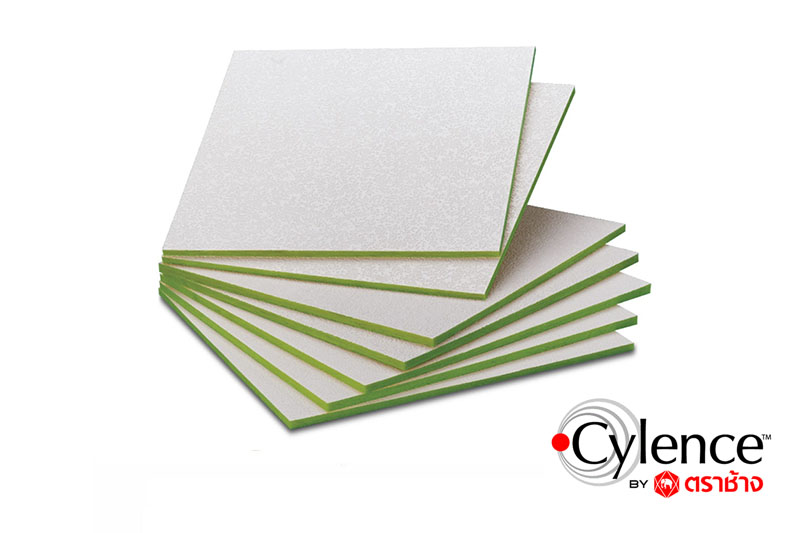
- Absorbing tiles on a T-bar grid — SCG Cylence Armax, a glass-wool tile with a white vinyl face and aluminium foil backing, 19 and 25 mm thick, 600 × 600 and 600 × 1200 mm. The manufacturer recommends hold-down clips so tiles do not lift with air-pressure differences. Its sound-absorption values are being checked against the manufacturer's documents; please ask
- Absorbing boards glued onto a smooth ceiling — M-Board, a mineral-fibre board 300 × 600 mm, 12 mm thick, 18 boards per box covering 3.24 m². Its NRC of 0.53 is a Get Best Sound measurement on an unpainted board, not a manufacturer report. Do not paint it, and fix it onto dry, flat surfaces with no leaks
For fire behaviour, check the test results in each product's documents against the building's requirements — see Fire performance terms. Ceiling installation is work at height and should be done by installers with the right equipment.
See solution: Echoey rooms
Sources
- ASTM C423 — measurement of sound absorption in a reverberation room; definitions of NRC and SAA (ASTM standard page and summary by Intertek)
- ASTM E795 — Standard Practices for Mounting Test Specimens During Sound Absorption Tests (Type A and E-400 mountings)
- Rockfon (ROCKWOOL Group) — Acoustics FAQ: definitions of α, αw, ISO 11654 classes A–E and NRC
- Rockfon — Rockfon Sonar product page: absorption at different suspension depths; cleaning guidance
- Rockfon — Humidity and water resistant ceilings
- SCG — SCG Armax acoustic ceiling tile product page
- Get Best Sound — M-Board product page and measurement
Related products
Categories and example products for this topic
- SCG Cylence Armax — White-vinyl glass-wool tile, 600×600 and 600×1200 mm, for laying into a T-bar grid.
- M-Board — Mineral-fibre board 300×600×12 mm glued onto an existing smooth ceiling.