Loud, echoey restaurants and cafés where you can't hear each other: what to do?
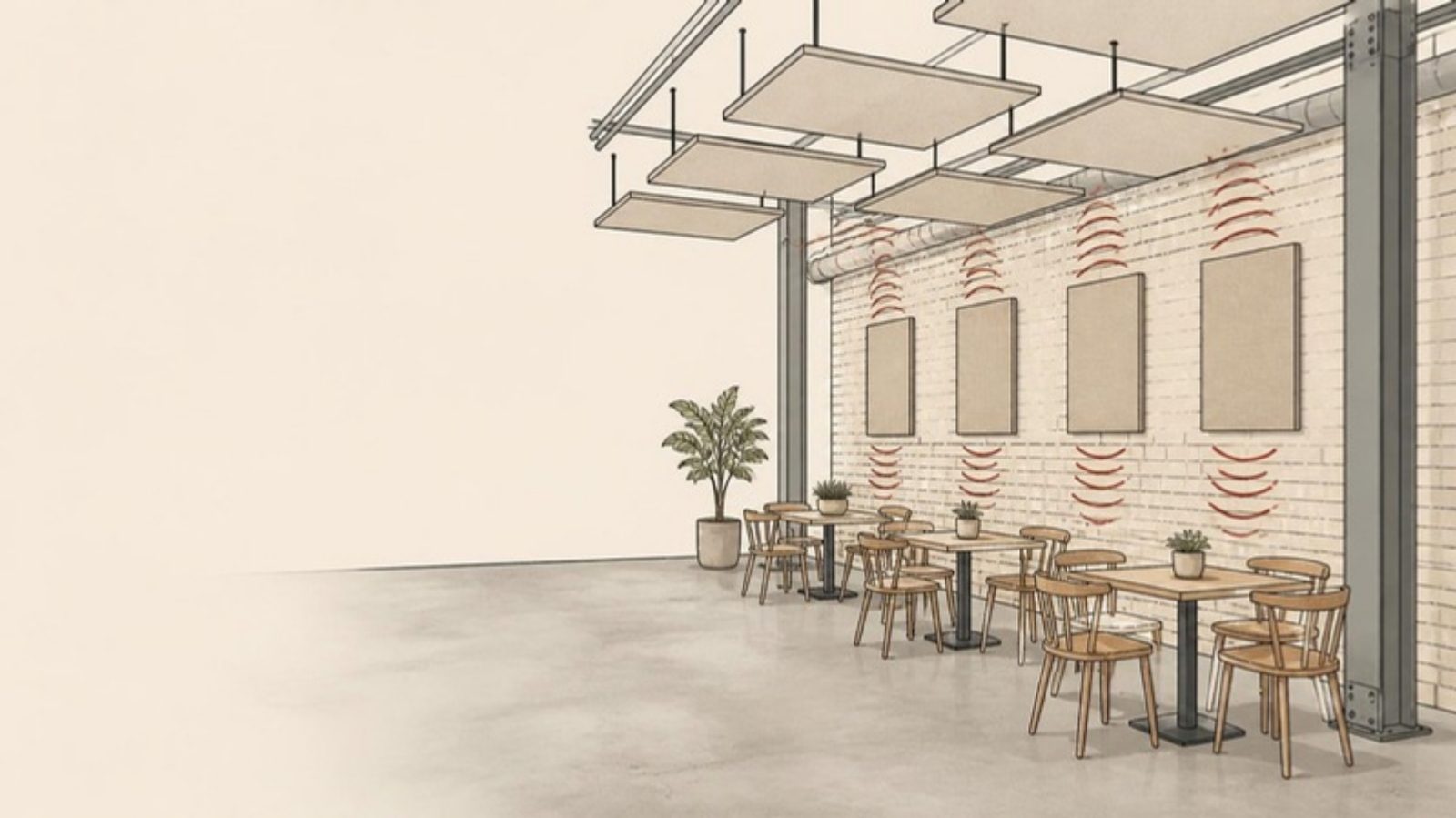
A room whose floor, walls and ceiling are all hard builds up reflected sound. As the surrounding noise rises, people speak louder without noticing, so the whole room keeps climbing. The main fix is to add enough sound absorption, starting with the ceiling and the upper walls, to cut the reflections that linger in the room. Absorption makes conversation easier, but it does not make a restaurant quiet and does not stop sound leaving the premises.
Why does it keep getting louder as it fills up?
Two things work together.
1. Hard surfaces reflect almost all sound. Loft-style venues often have polished concrete floors, bare brick or cement walls, large glazing and an exposed soffit. These surfaces send sound back into the room, so voices, cutlery, coffee machines and music linger and overlap. For the basics see Reverberation and reverberation time.
2. People speak louder when their surroundings are loud. This is the Lombard effect: talkers raise their vocal effort involuntarily in noise. When one table speaks up, that becomes noise for the next table, which speaks up in turn, and the level of the whole room climbs in a loop. A reflective room enters this loop sooner and goes further.
Research on restaurant acoustics therefore treats the noise level as depending on the number of people relative to the room volume and the amount of absorption. One proposed concept is "acoustical capacity": the largest number of people for which reasonable conversation is still possible, calculated from the room's volume and reverberation time. A venue that seats more people than its acoustical capacity tends to be too loud when full.
What absorption does
- Cuts the build-up of reflections — the overall level drops and sound no longer trails
- Slows the raise-your-voice loop — with a lower background, people do not push their voices as hard
- Makes the person opposite easier to hear — their direct sound stands out more against the room's reflections
The result depends on the total absorption area (absorption coefficient × area installed) relative to the size of the venue and the number of seats. A few decorative panels in a large room change little.
Where to add absorption
- The ceiling or the underside of the floor above — the largest unobstructed surface, and out of customers' reach. With an exposed soffit, material can go between services and beams or hang as panels below the structure
- Upper walls — above seat backs and arm's reach, especially two hard walls facing each other
- Walls near noisy spots — the bar, coffee machines and grinders, clearing stations, the kitchen entrance
- Furnishings that help a little — upholstered banquettes and chairs, heavy curtains, rugs; useful, but rarely enough alone
The amount should be calculated from the size of the venue, the number of seats and the chosen material. A first-estimate method is in Echoey meeting rooms; where possible, measure reverberation before and after.
Choosing materials for a venue
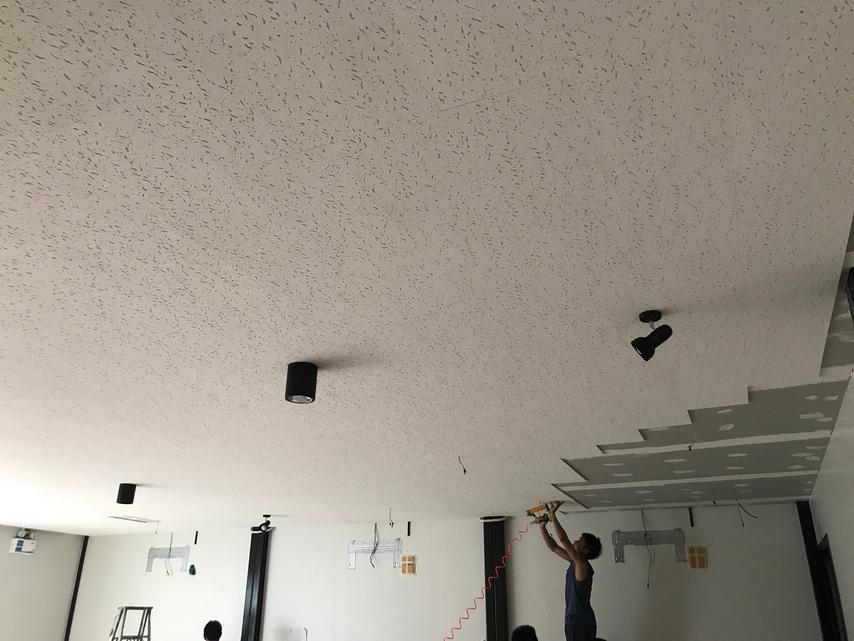
- Existing smooth ceiling — a glue-on absorbing board fixed over the old ceiling without removing it, such as M-Board, a mineral-fibre board 300 × 600 × 12 mm. Its NRC of 0.53 is a Get Best Sound measurement on an unpainted board, not a manufacturer report. Do not paint it to match the interior, because absorption drops, and fix it onto dry surfaces with no leaks or high humidity
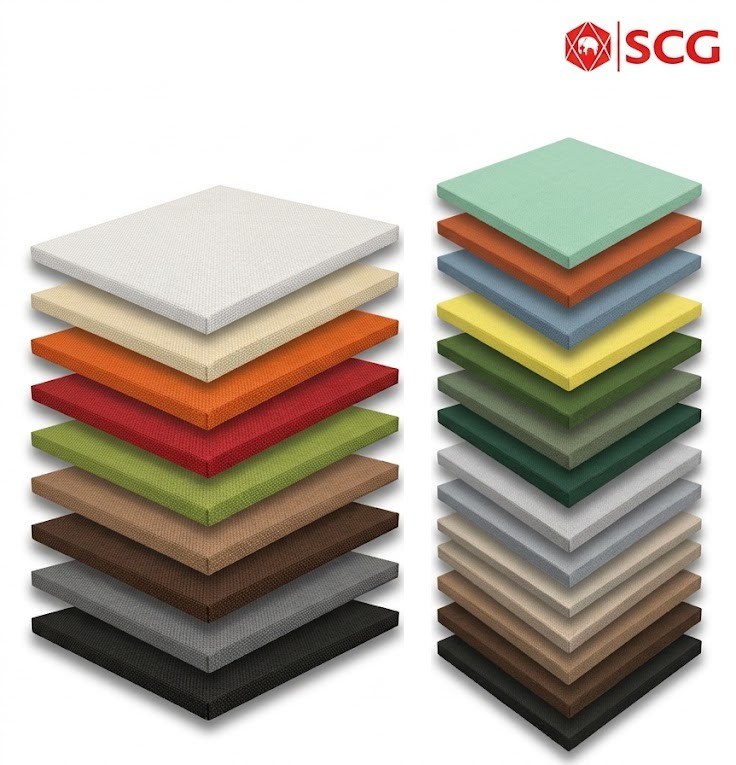
- Walls that need a finished look — fabric-wrapped wall panels such as SCG Cylence Zandera, 25 mm glass wool in 9 standard colours, fixed with adhesive to gypsum, fibre-cement or concrete walls
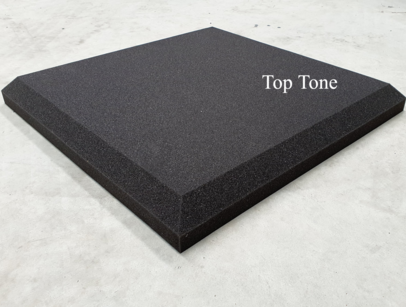
- Specific corners such as private rooms or a live-music corner — acoustic foam panels such as Top Tone, in several profiles, grey-black. See what to check in Acoustic foam panels
What a restaurant must consider beyond an ordinary room:
- Grease and humidity — porous materials and fabric faces hold stains and smells. Keep them away from cookers and greasy air, and ask how each product is cleaned
- Fire safety — a restaurant holds many people. Ceiling and wall finishes should have fire-behaviour test results that match the building's requirements; always ask for the documents of the exact product. See Fire performance terms
What absorption cannot do
Absorption is not sound insulation
- It does not keep sound in. Music or customer noise that disturbs neighbours or the floor above has to be dealt with at the walls, ceiling, doors and leaks. See Do sound absorbing panels stop noise leaving a room?
- It does not reduce the direct sound from the next table when tables are very close; spacing and screens affect that part
- It does not reduce noise at the source — loud music, grinders, extraction fans need to be handled at the equipment or the volume control
- A packed room can still be loud. Absorption lets the room start from a lower level, but no material makes a full restaurant quiet
See solution: Echoey rooms
Sources
- J. H. Rindel — research on noise and verbal communication in eating establishments (Applied Acoustics 2010; the acoustical capacity concept, 2012), cited via J. Paine's MSc thesis, University of Nebraska-Lincoln (2021), "Studying Acoustical Characteristics of Occupied Restaurants"
- Lombard effect — general definition (Wikipedia: Lombard effect) and an article by Commercial Acoustics (topic research only)
- Ecophon (Saint-Gobain) — Rooms with absorbent ceilings
- ASTM C423 — measurement of sound absorption and definition of NRC (summary by Intertek)
- Product documents: SCG Cylence Zandera installation guide, M-Board measurement by Get Best Sound, Top Tone product page
Related products
Categories and example products for this topic
- M-Board — Glues onto the venue's existing smooth ceiling — no removal or new grid.
- Top Tone — Acoustic foam in 10 profiles, fixed with water-based adhesive, for specific corners.
- SCG Cylence Zandera — 25 mm fabric-wrapped glass-wool panel in 9 colours — absorption plus a wall finish.
Sound absorption · Glass wool
SCG Cylence Zandera
- Thickness
- 25 mm
- Density
- 100 kg/m³
- Sound absorption (NRC)
- 0.75