Acoustic foam panels: how do they work and where do they help?
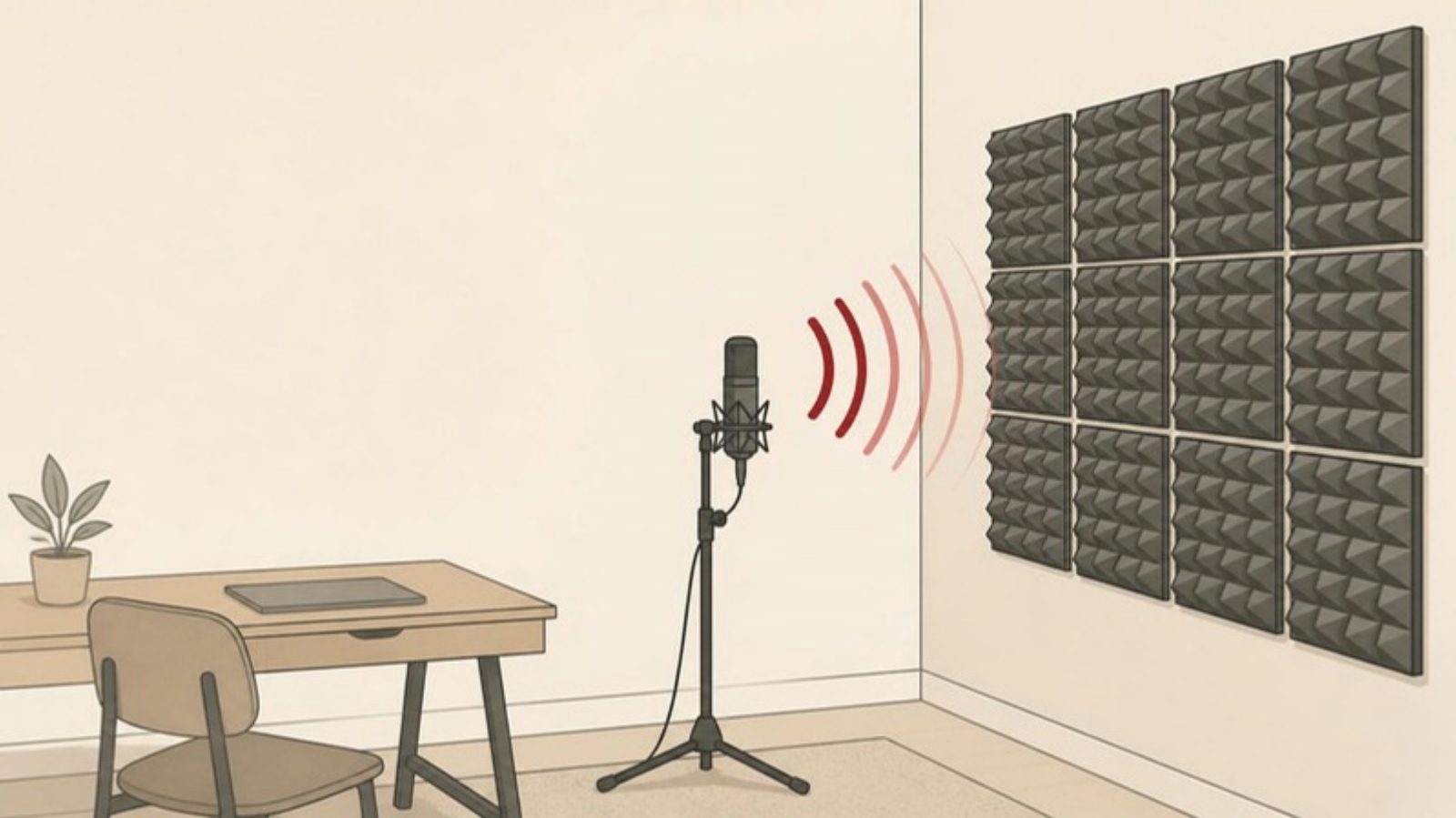
Acoustic foam is an open-cell foam that air can move through. Sound entering it loses energy to friction in the pores, so it reduces echo and reflections inside a room, mainly at mid and high frequencies. Thickness decides how far down towards the bass it works. Acoustic foam does not stop sound passing through walls, and before fixing it in a building you should ask the seller for fire-behaviour test results for that exact product.
How does acoustic foam absorb sound?
Acoustic foam is a porous absorber, like glass wool and stone wool. The foam has tiny pores that are connected to each other. When a sound wave moves air in and out of the pores, friction turns part of the sound energy into a very small amount of heat, so less sound is reflected back into the room.
That is why foam for absorption must be open-cell. In closed-cell foams — elastomeric pipe insulation or PE foam, for example — air cannot move through the material, so they absorb little sound. See Closed-cell vs fibrous insulation.
What does thickness change?
A porous material works well where the air is moving a lot, but right at a hard wall the air hardly moves. Bass has long wavelengths, so it needs material that reaches further out from the wall. As a result:
- Thin panels absorb treble and mid frequencies but barely touch the bass
- Thicker panels absorb down to lower frequencies
- An air space behind the panel lets the same thickness absorb lower frequencies better
- Deep bass needs impractical thickness; music rooms or home theatres with a bass problem usually need thick material or other types of absorber as well
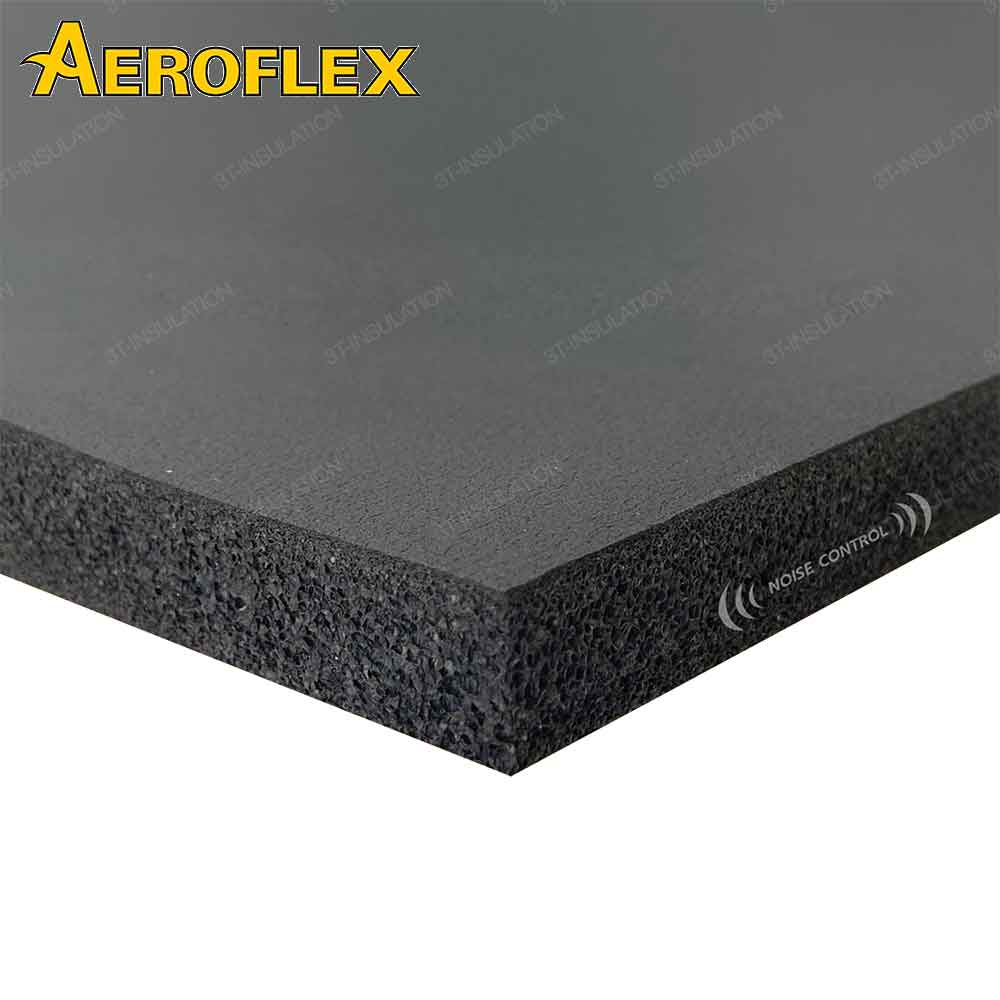
An example from a manufacturer's document: the open-cell duct lining Aeroflex ACOUSTEX, 25 mm thick, has absorption coefficients to ASTM C423 of 0.19 at 250 Hz, 0.60 at 500 Hz and 1.00 at 1000 Hz (NRC 0.65; the document does not state the test mounting). A 25 mm layer absorbs a lot in the mid and high range but far less at low frequency. How to read such a table is covered in Sound absorption coefficient.
Wedge, pyramid, egg crate or flat?
A surface profile is made by cutting some of the foam away. What to keep in mind:
- At the same overall thickness, a profiled panel contains less material than a flat one, and what has been removed is the part furthest from the wall — the part that works hardest. A profiled panel therefore does not automatically absorb more than a flat one
- Different profiles can give different absorption by frequency, so compare by the test results for that profile and thickness, not by shape
- In practice the profile is mainly about appearance. Get the thickness and quantity right for the room first, then choose the pattern
Where it works — and where it doesn't
Suited to reducing echo and reflections in small to medium rooms: recording and voice-over rooms, streaming rooms, rehearsal rooms, home theatres, small meeting rooms — fixed to walls that reflect sound straight back to the listener or the microphone, and to parallel hard walls.
Not suited, or of little effect
- Blocking sound from next door or keeping sound in — foam is light and porous; sound passes through it. Sound insulation is a matter for the wall system. See Do sound absorbing panels stop noise leaving a room?
- Bass problems — for the thickness reason above
- Covering every surface — the room becomes too dead and music sounds dry. Work out the quantity from the room's size and use
- Damp, greasy or sunlit locations — ask the seller whether the product is suitable
How is it fixed?
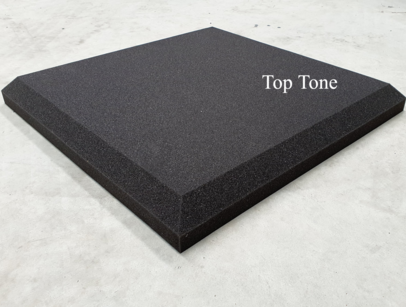
Acoustic foam panels such as Top Tone (grey-black, 10 profiles, mostly 2 in thick) are fixed with a water-based construction adhesive, which has little odour and grips well.
- Clean the wall so it is dry and free of dust and grease
- Set out the layout first so lines and patterns meet neatly
- Apply adhesive to the back of the panel and press it onto the wall; one tube covers about 2–2.5 m²
- Spray adhesives are not recommended if the room must be used straight away, because most smell strongly
Ceiling work and work at height should be done by installers with the right equipment.
Fire questions to ask the seller
Foams differ widely in how they burn
After the fire at The Station nightclub in the United States (2003), NIST reported that the polyurethane foam lining the walls and ceiling of the stage area was a key reason the fire spread so fast. In NIST's tests, foam without fire retardant ignited within seconds, while fire-retarded foam did not ignite under similar conditions. NIST recommended that non-fire-retarded flexible polyurethane foam be forbidden as a finish material in nightclubs.
Before fixing acoustic foam in a building, especially where many people gather, ask the seller:
- Is there a fire-behaviour test report? To which standard, and with what result?
- Is the report for the same product, colour and thickness you are buying?
- Is it a test for building interior finishes, or another kind of test — for example for upholstery filling — which is not interchangeable?
- Does the result meet the building's or project's requirement?
Words like "flame-retardant" or "fireproof" without a standard and a report are not enough to decide on. See Fire performance terms. For Top Tone we currently have no sound-absorption values or fire test results that we can publish; please ask before using it where requirements apply.
If the project calls for non-combustible material, consider glass-wool or stone-wool absorbers instead — see How to choose sound-absorbing material.
See solution: Echoey rooms
Sources
- Sound On Sound — Choosing & Using Porous Absorbers: principle of porous absorbers, open cells, thickness, air gap and the effect of profiles
- NIST — The Station Nightclub Fire (2003): role of polyurethane foam and recommendations on finish materials
- ASTM C423 — measurement of sound absorption in a reverberation room (summary by Intertek)
- Aeroflex Co., Ltd. — ACOUSTEX catalogue (AG/NOV 2025): absorption coefficients by frequency
- Get Best Sound — Top Tone product page: profiles, thickness and fixing method
Related products
Categories and example products for this topic
- Top Tone — Acoustic foam in 10 profiles, mostly 2 in thick, fixed with water-based adhesive.
- Aeroflex ACOUSTEX — Open-cell duct lining with per-frequency absorption data in the manufacturer's catalogue.
Duct and HVAC insulation · Acoustic foam
Aeroflex ACOUSTEX
- Thickness
- 25 mm
- Sound absorption (NRC)
- 0.65
- Service temp.
- -20 – 85 °C