Sound insulation · Stone wool
ROCKWOOL Safe 'n' Silent Pro
- Thickness
- 25–100 mm
- Density
- 40–100 kg/m³
- Sound absorption (NRC)
- 0.90–1.00
Sound coming in or going out (sound insulation)
Echoey rooms (sound absorption)
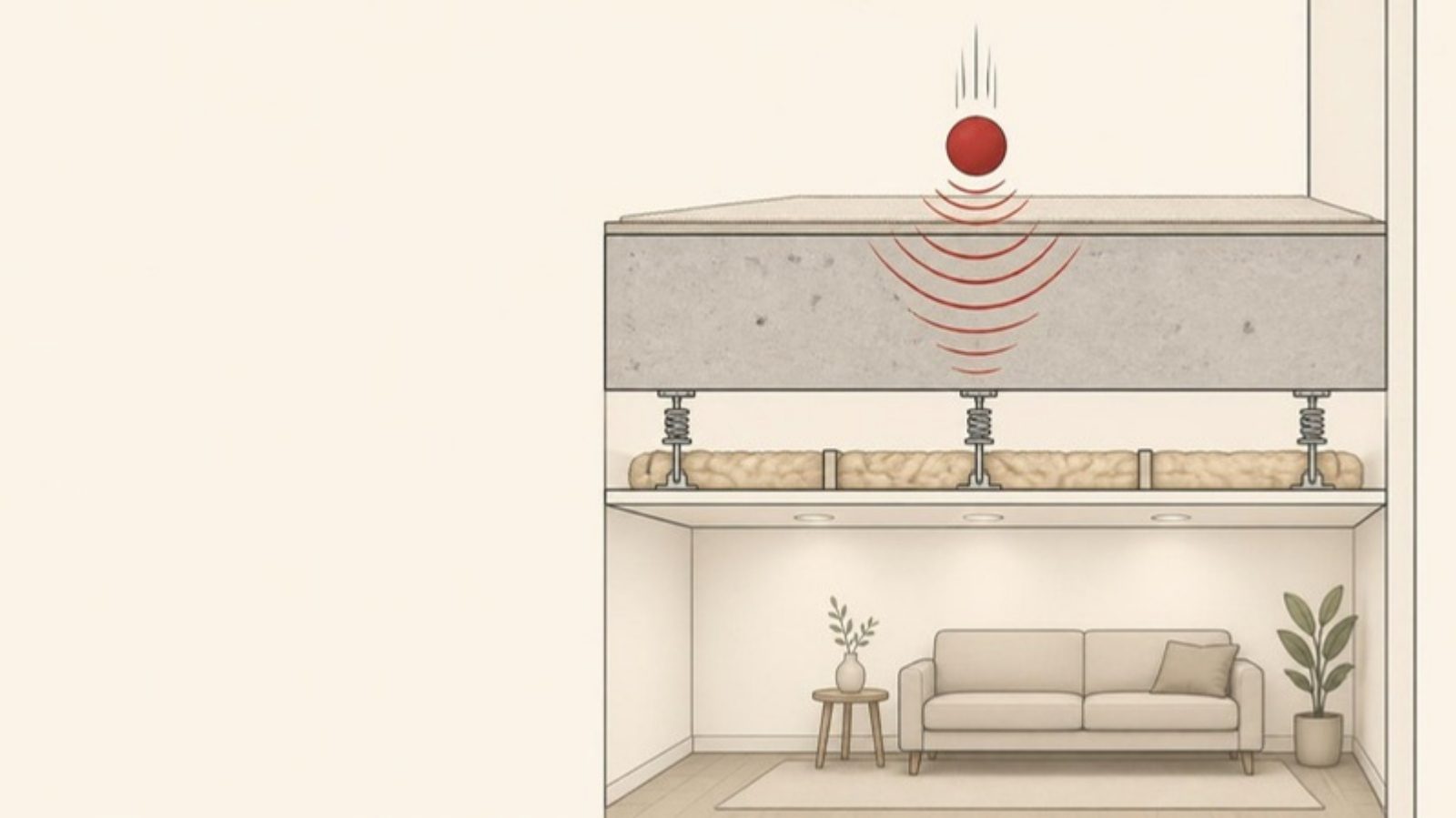
Footsteps, dropped objects and dragged chairs from upstairs are impact sound: the force goes straight into the floor and then travels on through the structure. The more effective fix is on the floor above — a soft covering, a resilient underlay or a floating floor. If you can only work from the room below, build a suspended ceiling that is decoupled from the structure, airtight and insulated in the cavity. That helps to a degree, but low-frequency thuds and sound coming down the walls can remain.
A floor that blocks speech well may therefore still be poor against footsteps. The two are measured differently and fixed in different places. For the basics of sound paths see Sound transmission through walls and flanking.
If the upstairs owner cooperates, or both floors are yours, start with the floor.
| Method | Principle |
|---|---|
| --- | --- |
| Carpet or rugs with underlay where people walk most | A soft surface reduces the impact force before it enters the floor; works on heels and dropped objects |
| Resilient underlay under timber, laminate or vinyl flooring | Separates the floor finish from the structure. The result depends on the underlay type and thickness as tested by the manufacturer with that floor |
| Floating floor | A new floor surface resting entirely on a resilient layer, not touching the walls and with no nails or screws through to the structure. Loads and edge details should be set by a designer |
Tiles or stone laid directly on the floor with no resilient layer usually make impact noise more noticeable than a floor with a soft finish.
When the floor above cannot be touched, the option is a sound-insulating ceiling under the soffit. The key components are:
As one example, a set of field measurements on a concrete slab in a single building (Richards & Park, 1996) found that adding a resiliently suspended gypsum ceiling improved the field rating FIIC by 6 to 15 points, depending on what was laid on the slab. Those figures belong to that building and those systems and are not a guarantee for any other room, but they show that a ceiling does help and that the result varies widely with the floor above.
Laying insulation on an existing ceiling that is rigidly fixed to the soffit, or on a T-bar ceiling full of joints and light fittings, does little for footsteps. Insulation works well when it sits in the cavity of an airtight ceiling that is decoupled from the structure. Absorbing panels or foam stuck under the ceiling do not solve this problem either. See Does sound absorption block noise?
| Rating | Standard | How to read it |
|---|---|---|
| --- | --- | --- |
| IIC (Impact Insulation Class) | Laboratory test to ASTM E492, rating calculated to ASTM E989 | Higher means better impact insulation |
| Ln,w | Rated to ISO 717-2 from laboratory measurements | It is the sound level measured in the room below — lower is better |
| L'nT,w | Rated to ISO 717-2 from measurements in a real building | Lower is better; includes that building's flanking paths |
The test uses a standard tapping machine hammering on the floor while the sound level is measured in the room below over roughly 100–3,150 Hz. All of these are ratings of the complete tested floor-ceiling assembly — floor finish, underlay, structure, ceiling frame, boards and insulation — not of any single insulation product or underlay. A rating from one assembly cannot be transferred to another.
One more thing to know: real footsteps contain low-frequency sound below the range these ratings cover, so an assembly with a good rating may still let some thuds through, especially with lightweight floor structures.
See the solution and related products: Noise from next door / neighbours · Sound insulation · Why a double-leaf wall with a cavity insulates better
Categories and example products for this topic
Sound insulation · Stone wool
Check the message below, then press “Open LINE”. On a phone LINE opens with this message; on a computer LINE shows a QR code to scan with your phone. If LINE does not open, copy the message into the chat, or call us.
Add us on LINE: @x2525 · Call 062-195-1909