Sound insulation · Stone wool
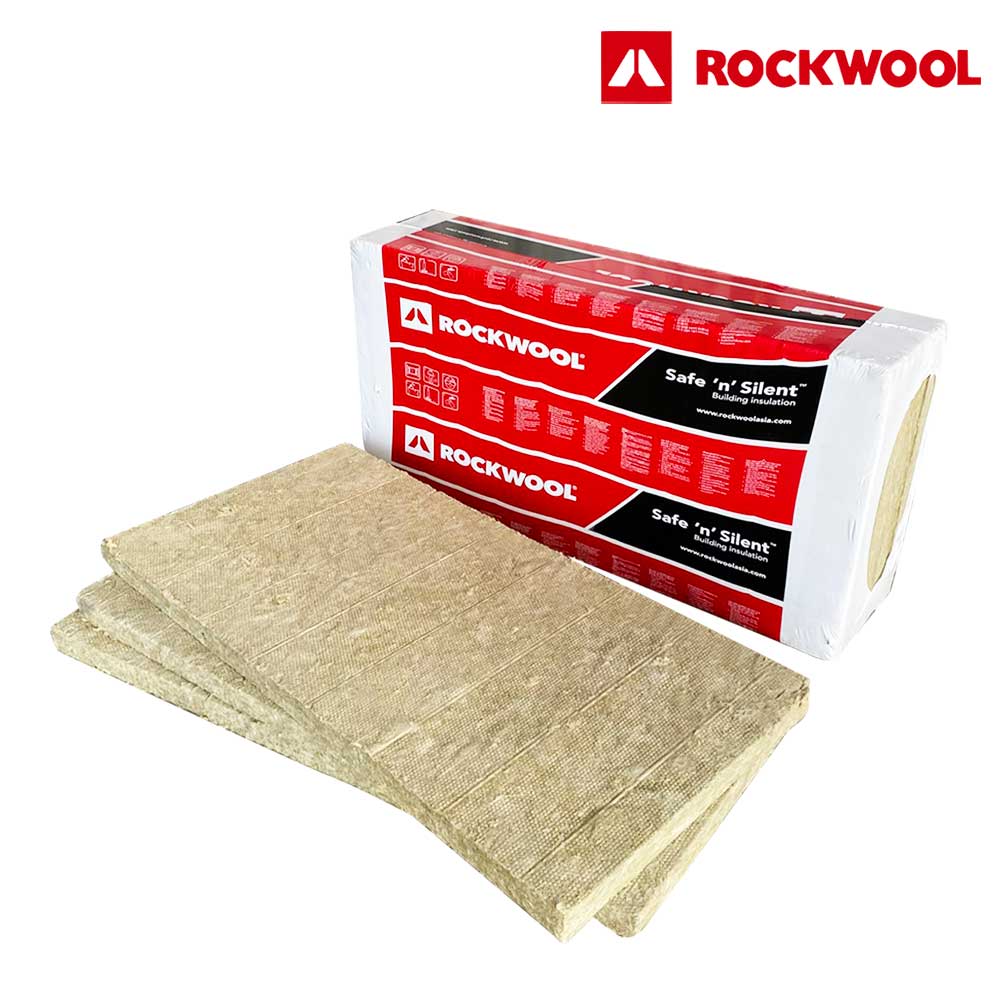
ROCKWOOL Safe 'n' Silent Pro
- Thickness
- 25–100 mm
- Density
- 40–100 kg/m³
- Sound absorption (NRC)
- 0.90–1.00
Sound coming in or going out (sound insulation)
Echoey rooms (sound absorption)
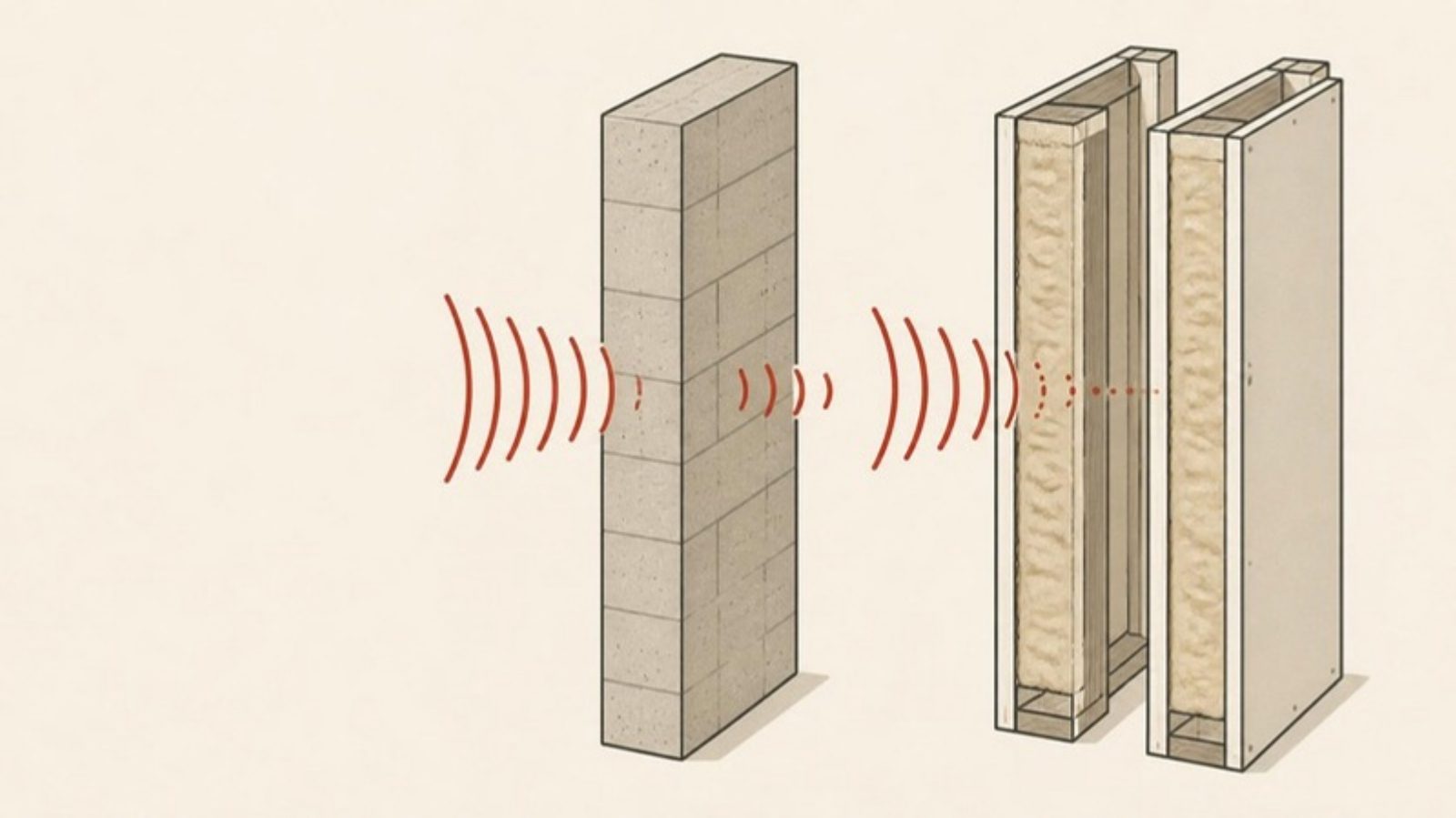
A single-layer wall follows the mass law: doubling the mass per unit area adds only about 6 dB of sound insulation, so simply making it thicker becomes heavy and poor value. A double-leaf wall with an air cavity makes sound pass two barriers. When the two leaves are not rigidly connected, the cavity is deep enough, there is sound-absorbing insulation in the cavity and all leaks are sealed, the sound insulation above the system's resonance frequency rises much faster than the mass law predicts for the same total mass.
For a single-layer wall, mass per unit area is the most important factor in airborne sound insulation. NRC Canada's Canadian Building Digest 239 explains that:
In addition, stiff panels have a frequency range where they insulate worse than the mass law, known as the coincidence effect. A thick, stiff single wall therefore does not improve in line with its weight at every frequency. The same Digest concludes that double-layer construction is the more practical way to reach high sound insulation without excessive weight.
A double-leaf wall is two faces separated by an air cavity — a steel-stud drywall partition boarded on both sides, for example, or a masonry wall with an added drywall lining. It behaves as a mass–spring–mass system in which the air in the cavity is the spring. Its performance depends on four things: the mass of each face, the cavity depth, sound-absorbing material in the cavity, and how rigidly the two faces are connected.
A mass–spring–mass system has one frequency at which it vibrates especially easily.
| Frequency range | How the double-leaf wall behaves |
|---|---|
| --- | --- |
| Below the resonance | The two faces move together; performance is close to a single wall of the same total mass |
| Near the resonance | Insulation is worse than the same total mass would give |
| Above the resonance | Insulation rises much faster than the mass law — this is the advantage of a double-leaf wall |
The design aim is to push the resonance down below the range of sound you need to block, which is done by increasing the cavity depth and increasing the mass of the faces. CBD-239 recommends designing for a resonance below about 80 Hz.
Fixing board on thin furring, or with adhesive dabs close to a masonry wall, traps a layer of air only a few millimetres thick behind it. The resonance then moves up into the speech range. CBD-239 notes that the sound rating can end up below that of the original unlined wall. A few more centimetres of air space make a clear difference.
If both faces are fixed rigidly to the same studs, vibration runs through the studs from one face straight to the other. CBD-239 compares rigid connections to an acoustic "short circuit", much like a thermal bridge in insulation. The decoupling methods NRC lists are:
NRC's Construction Technology Update No. 1 states that isolating the two faces is the major factor. Once they are isolated, adding mass, deepening the cavity and adding absorbing material deliver their full benefit, and wider stud spacing helps a little more.
Fibrous insulation in the cavity damps reverberation and air resonance inside it, but how much it helps depends heavily on decoupling. CBD-239 gives these examples:
These figures are ratings of complete walls in that set of tests — not of the insulation, and not values that apply to every wall. The same Digest also states that for walls of normal thickness the density and type of absorbing material have little effect; ordinary glass wool or mineral wool works well. Slab or batt products for this job include ROCKWOOL Safe 'n' Silent Pro, SCG Cylence ZoundBlock and ISO NOISE Standard. More in Why cavity insulation improves sound insulation.
A wall that is well designed in every other way still loses performance through small openings at the perimeter, outlets, doors and pipe penetrations, because sound passes through air without having to go through the mass of the wall. Seal the perimeter and deal with every penetration. See Sound transmission through walls and flanking.
The same principles apply to ceilings and floors. See Soundproofing a ceiling against the floor above, and for an existing wall Hearing the neighbours through the wall?
STC and Rw are measured on complete walls in a laboratory (ASTM E90 / ISO 10140-2). We therefore do not assign an STC value to any single insulation product or board. If you need a figure you can rely on, choose a wall system the manufacturer has test data for and build it exactly to that system. See What are STC and Rw?
See the solution and related products: Noise from next door / neighbours · Machine noise · Sound insulation
Categories and example products for this topic
Sound insulation · Stone wool
Sound insulation · Glass wool
Check the message below, then press “Open LINE”. On a phone LINE opens with this message; on a computer LINE shows a QR code to scan with your phone. If LINE does not open, copy the message into the chat, or call us.
Add us on LINE: @x2525 · Call 062-195-1909