Why does a room echo, what does it do, and how is it measured and fixed?
7 min read · Written by our team · Updated 16 Oct 2026
In short
A room reverberates because sound hits hard surfaces (concrete, glass, tiles, plain plasterboard) and bounces back and forth many times before it dies away. Large, empty rooms with no absorbing material reverberate most. The effects are unclear speech, listening fatigue, noise that feeds on itself and difficult video calls. Reverberation is measured as a number, the Reverberation Time (RT), and it is fixed by adding sound-absorbing material in an amount and at positions calculated from the room, not by adding panels until it feels right.
What makes a room echo
Sound from a voice or a loudspeaker does not only travel straight to the listener. Most of it hits the walls, ceiling and floor first and comes back as overlapping reflections. If the surfaces reflect nearly everything, the sound circles the room many times before it runs out of energy: that is reverberation. A room reverberates more when:
Its surfaces are hard and smooth — concrete, render, glass, tiles, terrazzo and plain plasterboard reflect almost all sound. These are the standard finishes of ordinary buildings, so most rooms reverberate from the day they are built.
It is large or tall — sound travels further between reflections, so it lingers longer. RT grows with room volume.
It is empty — a room without curtains, carpet, upholstered furniture, bookshelves or people reverberates more than the same room furnished. Meeting rooms and classrooms are worse empty than in use.
Two hard walls face each other — sound bounces between them as a rattling flutter echo; clap once and you hear it.
There is no absorbing material at all — decorative but hard ceilings and walls. The fashion for glass and glossy finishes makes modern rooms more reverberant than older rooms with timber and fabric.
Note that reverberation has nothing to do with how loud the source is — a reverberant room is just as reverberant for a quiet voice — and nothing to do with noise from other rooms, which is a matter of sound insulation.
What reverberation does to a room, for better or worse
The downsides (ordinary rooms)
Unclear speech — the reflections of the previous word overlap the next; the consonants that separate words are masked and listeners guess from context. People far from the speaker and older listeners suffer most.
Listening fatigue — the brain works harder to pick words out of the reflections; long meetings and lessons become exhausting.
Noise that feeds itself — in a restaurant or lobby everyone raises their voice to be heard over the reverberation, which raises the overall level again.
Difficult video calls — the microphone picks up the reflections too; the far end hears a hall, and echo cancellation struggles until words drop out.
Turning up the loudspeaker does not help — it raises the direct sound and the reflections together, so clarity does not improve.
Flutter and discrete echoes — spoil recordings and music and blur where sounds come from.
The upsides (only in some rooms)
Reverberation is not always bad. Concert halls for classical music, churches and singing rooms rely on a designed amount of it to make music full and blended. "Fixing" reverberation therefore means tuning it to the use of the room, not deadening it: a room with too much absorption sounds dull and oppressive, and people far from the speaker hear less.
Room
Reverberation wanted
---
---
Classrooms, meeting rooms, video-conference rooms
Low — for clear speech
Open offices, restaurants, reception halls
Low to moderate — to limit noise build-up
Home cinemas, rehearsal rooms, recording rooms
Low and controlled — to a design
Classical concert halls, places of worship
Moderate to high — to a design
How reverberation makes speech unclear
The sound that reaches a listener in a room has three parts:
Direct sound — travels from the speaker's mouth to the ear without touching anything. It arrives first and carries what the word actually is.
Early reflections — bounce off nearby surfaces and arrive within about 50 milliseconds of the direct sound. The ear merges them with the direct sound, so they help: the voice sounds louder and clearer.
Late reflections (reverberation) — have bounced many times and arrive later than that. The ear does not merge them with the direct sound; they are heard as a tail dragging behind.
The trouble is that speech changes very fast: a syllable lasts only a few hundred milliseconds. In a room with an RT of 2 seconds, the tail of the previous syllable is still sounding when the next one starts, and the tails pile up. The results:
Consonants are masked — vowels (ah, ee, oo) are loud and long; the consonants that tell words apart (s, t, k, p, f) are quiet, short and high-pitched. The reverberant tail of a vowel buries the consonant that follows, so the listener hears all the "sound" but cannot separate the "words": "sit" and "fit", "pat" and "bat" start to sound alike.
The gaps between words disappear — the short pauses the brain uses to cut speech into words are filled with reverberation, and the sentence becomes one continuous mass.
It gets worse with distance — direct sound fades with distance, but reverberation is about the same level everywhere in the room. People at the back hear more reverberation than direct sound. The distance at which the two are equal is the critical distance; in a very reverberant room it can be only 1–2 metres from the speaker, and beyond it the listener is mainly hearing the reverberation.
Noise piles up — where several people talk, everyone's reverberation adds up into a bed of sound that masks the direct voice of the person you are trying to hear.
Turning up the volume does not help — a louder loudspeaker raises the direct sound and the reverberation by the same amount, so their ratio does not change and clarity stays the same (sometimes worse, because the total reverberant level becomes tiring).
Technically, speech clarity is measured by the Speech Transmission Index (STI) or by C50, the ratio of sound energy arriving within the first 50 ms to the energy arriving later. Both are tied directly to RT: the longer the RT, the lower C50 and the less intelligible the speech. Reducing RT with absorbing material removes only the late reflections while the direct sound stays the same, so the ratio improves and speech becomes clearer without anyone speaking louder.
How reverberation is measured
As a number: Reverberation Time (RT)
The figure used worldwide is RT or RT60: the time in seconds for the sound in the room to fall by 60 decibels after the source stops. The longer the RT, the more reverberant the room. A measurement to ISO 3382-2 works like this:
Excite the room — a loudspeaker plays noise that is cut off abruptly, or a short impulse such as a bursting balloon or a starting pistol.
A sound level meter or measurement microphone records how the level decays.
The decay time is evaluated, usually over a 20 or 30 dB drop and extrapolated to 60 dB (T20 / T30).
It is measured per frequency band (for example 125 Hz to 4000 Hz) and at several positions, then averaged, because a room often reverberates more at low frequencies than at high ones.
A good report is therefore not one number but a table of RT by frequency band, before and after treatment. Background reading: What are reverberation and RT?
Rough checks you can do yourself
Clap test — stand in the middle, clap once hard and listen. A long tail or a rattling flutter means the room reverberates. A screening check only; no number.
Phone apps — some RT60 apps give a rough figure, but phone microphones are limited, especially at low frequencies. Fine for comparing before and after in the same room; not for proving compliance.
Calculation from the room size — Sabine's relation RT ≈ 0.16 × V ÷ A (V = room volume in m³, A = total absorption area in m²) gives an estimate once you know how much each surface absorbs.
There is no single figure for every room. Published criteria include the US classroom standard ANSI/ASA S12.60, which sets a maximum RT of 0.6 s for classrooms up to about 283 m³, and the WELL Building Standard, which sets 0.6 s for conference rooms. If a project has its own requirement, that applies.
How reverberation is fixed
There is one principle: add enough sound-absorbing area to the room. Absorbing materials are porous or fibrous (glass wool, stone wool, polyester fibre, open-cell foam) and turn part of the sound energy into a little heat instead of reflecting it. The right sequence:
Set the target — what the room is for and roughly what RT it needs.
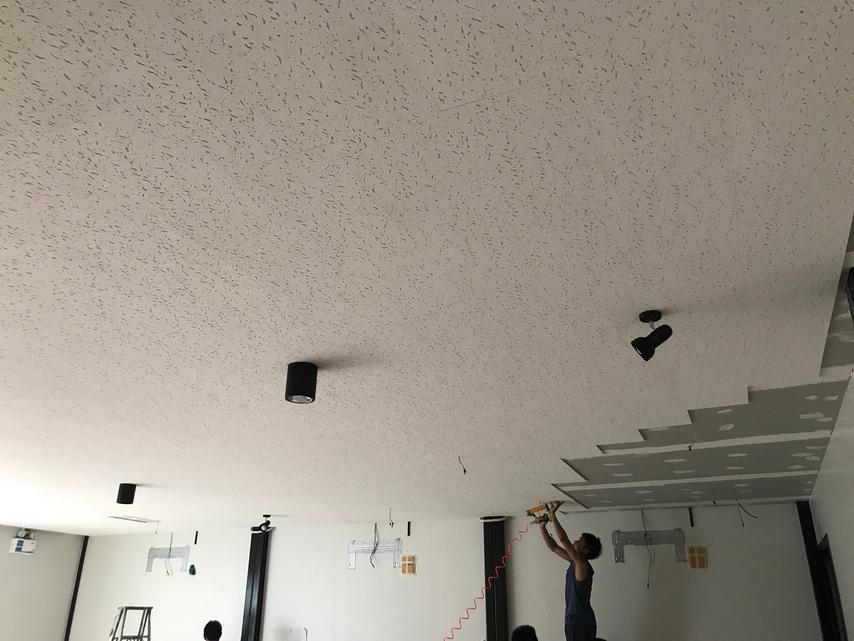
Choose the positions — the ceiling is usually the largest free surface and spreads the material across the room; the rear wall and facing walls stop flutter. Do not pile everything on one side.
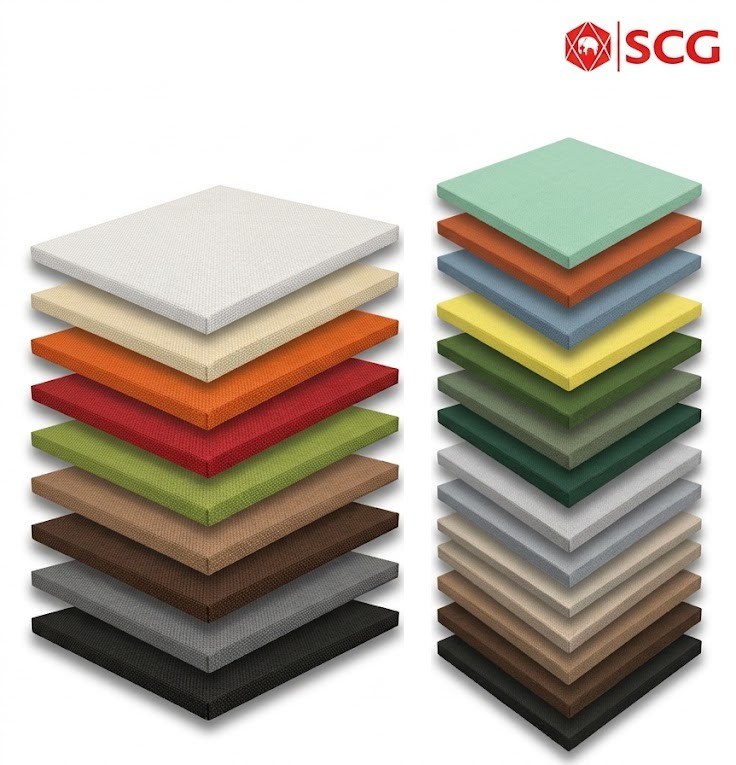
Choose the material — read the absorption by frequency band from the maker's test report (not just a single NRC); thickness and an air gap behind matter for low frequencies; consider fire behaviour and appearance. See Choosing sound-absorbing material
Install, then measure again — the calculation is an estimate; real rooms have glass, furniture and odd shapes. Measure RT after installation to confirm and top up if needed.
Things that help a little without panels: heavy curtains, carpet, upholstered furniture, bookshelves — rarely enough for a hard-surfaced meeting room or classroom.
What does not help, or helps little
A few scattered thin panels or egg-crate foam — too little area to change the RT of the room; reverberation depends on total area.
Painting over absorbing material — paint seals the pores and absorption drops.
A louder loudspeaker or a different microphone — does not reduce reflections.
Reverberation looks easy to fix because anyone can stick a panel on a wall, but a result that works and is worth the money needs decisions that cannot be guessed:
The right amount — too little wastes money and leaves the room reverberant; too much makes it dull and oppressive and costs more than needed. The right amount comes from the room volume, the existing surfaces and the material's absorption.
Frequency — a room that reverberates at low frequencies (male voices, air-conditioning, music) needs thick material or an air gap behind it; a thin panel with a pretty NRC may not fix it at all. Reading absorption by frequency band takes experience with test reports.
Position — long rooms, tall rooms and rooms with a glass wall need different layouts. Experience tells whether to start with the ceiling, the rear wall or both.
Real measurement — instruments measure RT to the standard and give before-and-after figures that can be checked, rather than an impression.
Everything that comes with it — fire behaviour of decorative materials in public buildings, dust and cleaning, fixing to ceilings full of services, and telling whether the client's problem is reverberation or noise from next door, which is fixed differently and at a very different cost.
Value — a survey and a calculation before buying usually cost less than buying the wrong material or the wrong amount and buying again.
Send photos of the room, its width, length and height, and what it is used for, and we will give a first assessment and suggest materials on LINE.
ISO 3382-2 — Acoustics — Measurement of room acoustic parameters — Part 2: Reverberation time in ordinary rooms (RT measurement, T20/T30, frequency bands)
ISO 354 / ASTM C423 — measurement of sound absorption in a reverberation room (the Sabine relation between RT, volume and absorption area)
ANSI/ASA S12.60 — Acoustical Performance Criteria, Design Requirements and Guidelines for Schools (via an Armstrong World Industries article)
WELL Building Standard v1 — Feature 78 Reverberation Time (conference rooms 0.6 s)
ROCKWOOL International — 5 facts about Acoustics and stone wool (2020): definition of reverberation time
Check the message below, then press “Open LINE”. On a phone LINE opens with this message; on a computer LINE shows a QR code to scan with your phone. If LINE does not open, copy the message into the chat, or call us.