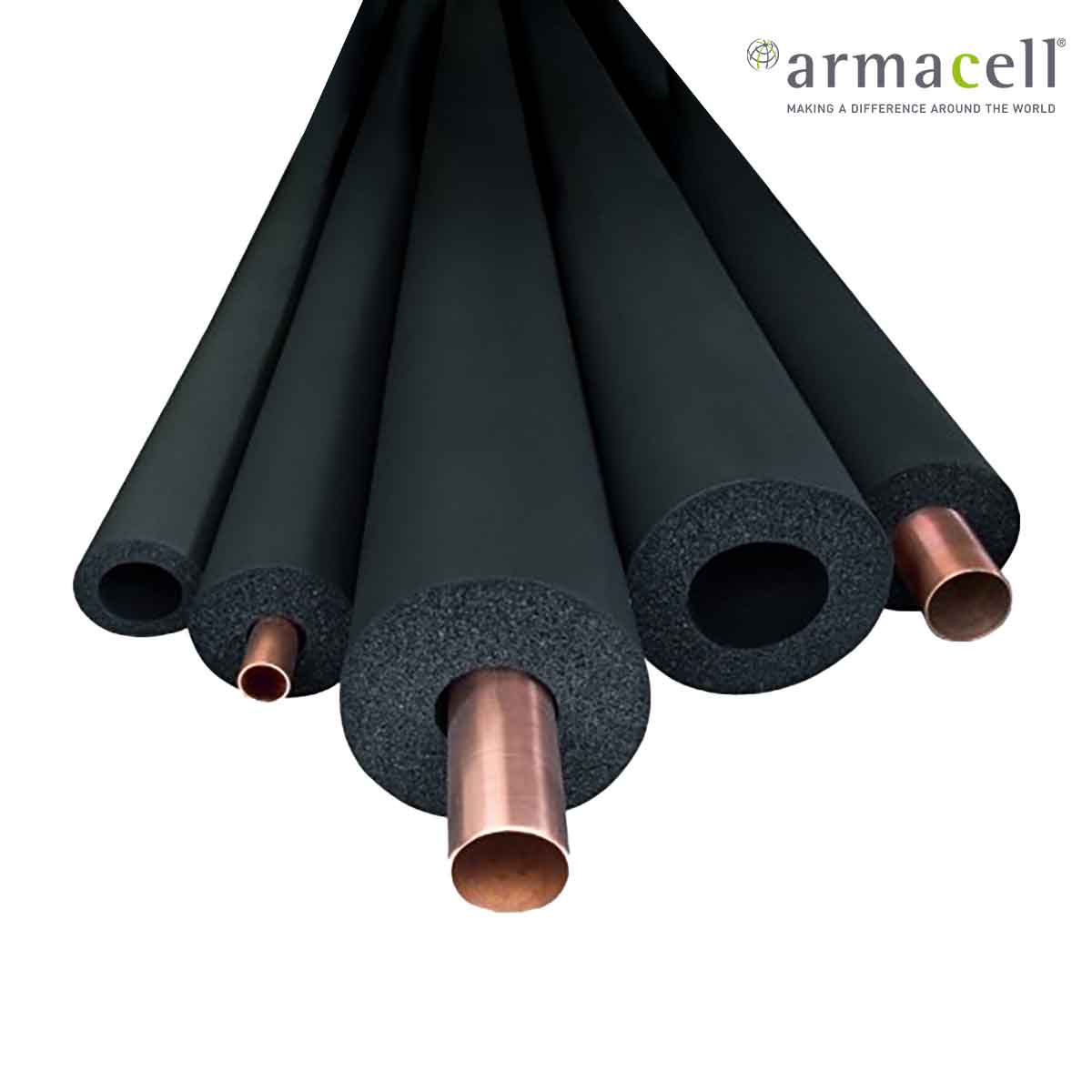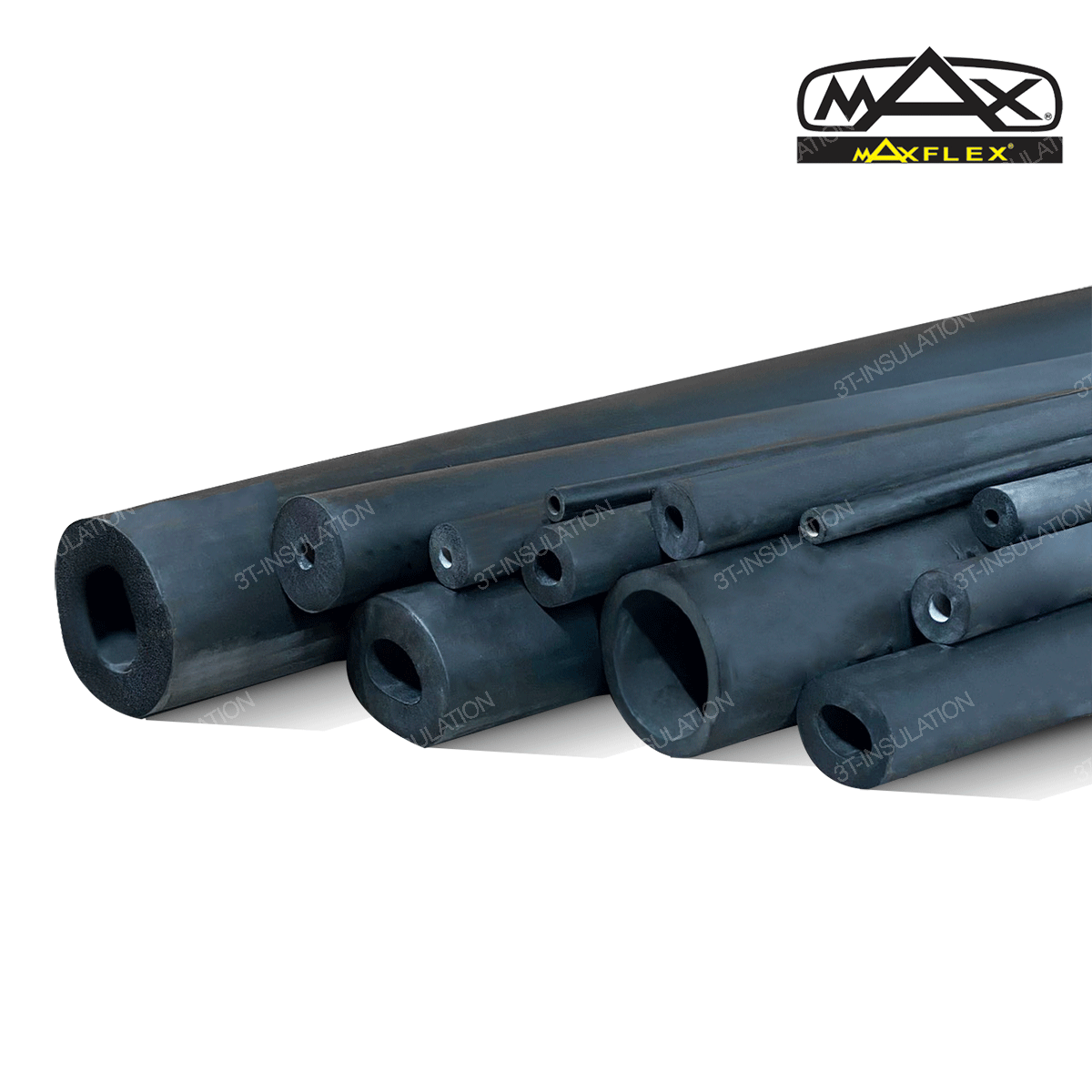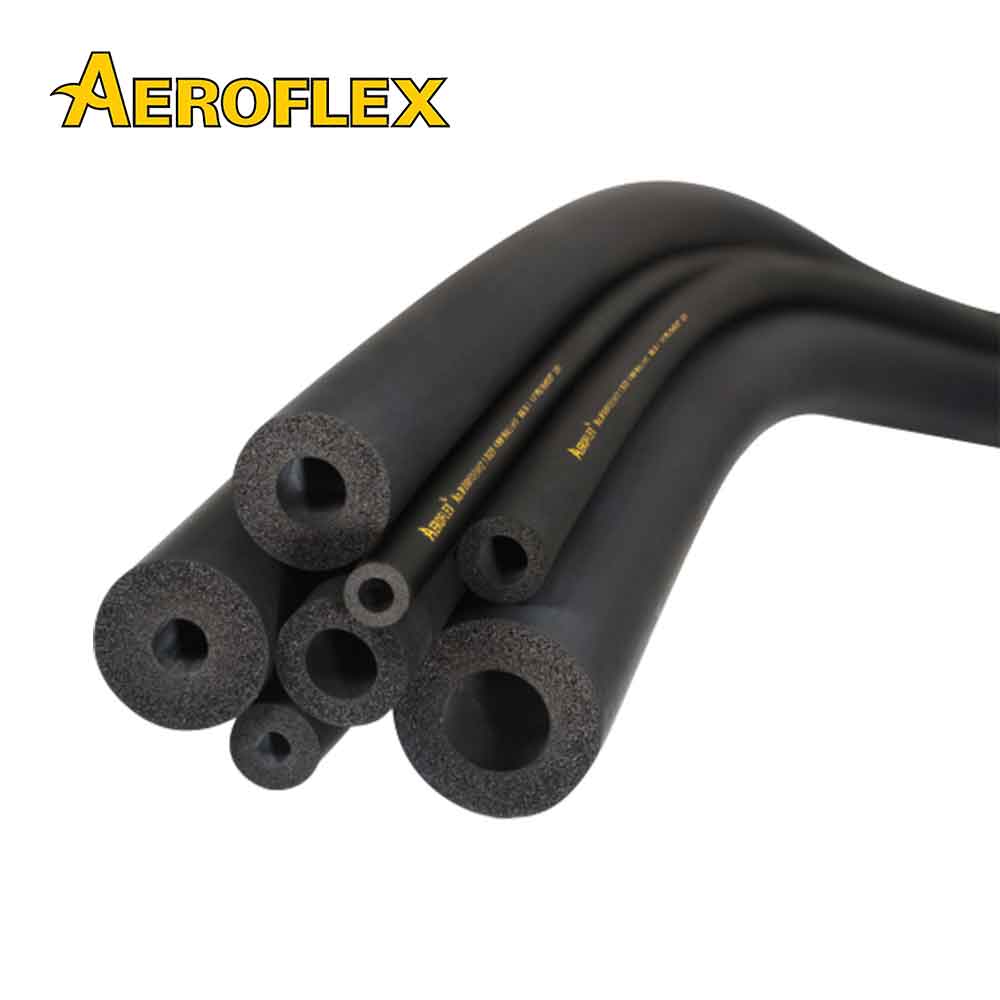
Pipe insulation · Elastomeric foam
AEROFLEX Tube Insulation
- Tube bore
- 6–165 mm
- Wall thickness
- 6–50 mm
- Service temp.
- -57 – 125 °C
Sound coming in or going out (sound insulation)
Echoey rooms (sound absorption)
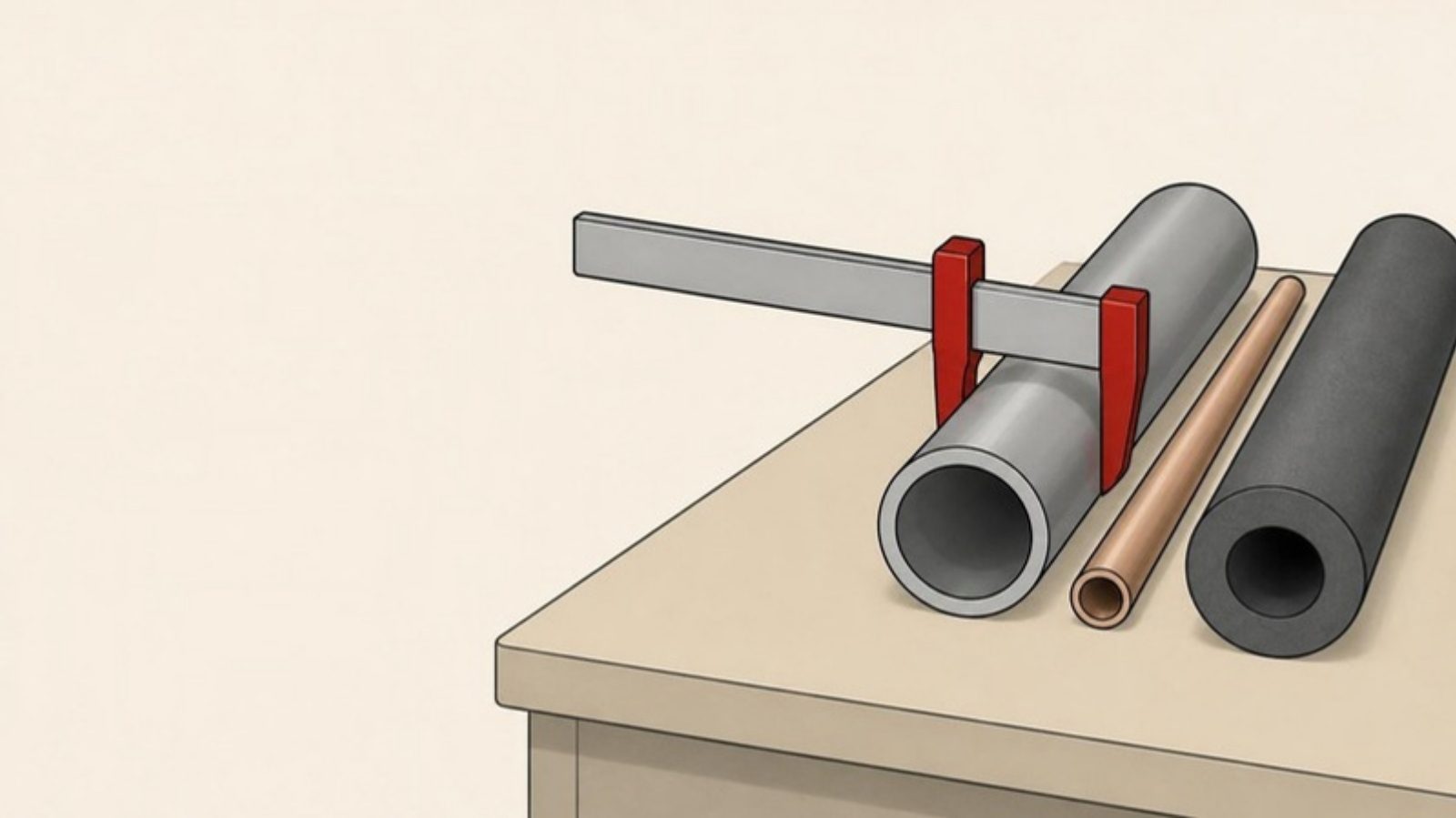
A pipe name such as "1/2 inch" is a nominal size, not a dimension you can measure. A 1/2 inch steel pipe has an outside diameter (OD) of about 21.3 mm, while a 1/2 inch air-conditioning copper tube has an OD of 12.7 mm. Tube insulation is sold by inside diameter (bore) + wall thickness, so it must be chosen from the pipe's actual OD, not from the name alone.
Steel pipe uses NPS (Nominal Pipe Size), with dimensions set out in ASME B36.10M. In Thailand it is usually called by "inches" or IPS. Three points matter:
Thai tradespeople often give sizes in "hun" (หุน), where 1 hun is 1/8 inch: 2 hun = 1/4 inch, 3 hun = 3/8 inch, 4 hun = 1/2 inch. It is only a way of saying fractions of an inch. You still need to know the pipe type to know the OD.
Each pipe type has its own standard and its own naming rule.
| Pipe type | How the size is named | What "1/2 inch" actually measures |
|---|---|---|
| --- | --- | --- |
| Steel pipe (NPS / IPS) | Nominal; OD larger than the name | OD about 21.3 mm |
| Copper tube for air conditioning and refrigeration (ACR, ASTM B280) | Named by actual OD | OD 12.7 mm |
| Copper water tube (ASTM B88 Types K / L / M) | Nominal; OD is 1/8 inch larger than the name | OD 5/8 inch (about 15.9 mm) |
| Plastic pipe such as PVC, PPR | By each pipe's own standard; PPR is usually named by OD in millimetres | Check the pipe specification or measure |
So the single name "1/2 inch" can mean at least three different ODs. Ordering insulation by name without stating the pipe type is likely to give the wrong size.
Pre-formed tube insulation is described by three numbers: bore × wall thickness × length per piece. The bore is made equal to or slightly larger than the pipe OD. Each manufacturer prints its matching table differently.
| Product | What the manufacturer's table prints | Example from the table |
|---|---|---|
| --- | --- | --- |
| AEROFLEX Tube | Bore in inches and millimetres, plus a steel pipe size for 14 bores | 7/8 inch (22 mm) bore pairs with 1/2 inch steel pipe |
| MAXFLEX FR Tube | Bore against copper, iron/PVC (IPS) and PPR pipe sizes | 22 mm bore pairs with 7/8 inch copper, 1/2 inch IPS and 20 mm PPR |
| ArmaFlex Class 1 | Bore against copper pipe OD (inch), steel pipe OD and DN | 22 mm bore pairs with 7/8 inch copper and DN 15 |
| SCG PCI | Steel pipe size (inch) with OD in millimetres | 1/2 inch steel pipe = OD 21.40 mm, 1 inch = 34.10 mm, 2 inch = 60.30 mm |
Note that insulation named "7/8 inch" bore fits a steel pipe named "1/2 inch". The number in the insulation name and the number in the pipe name do not have to match. What must match is the insulation bore and the pipe OD.
The AEROFLEX document prints matches for steel pipe only. For copper or other pipes, measure the OD and choose directly by bore. Our product page therefore offers both a "steel pipe size" selector and an "insulation bore" selector. SCG PCI is sized for steel pipe; copper tube is a separate model from the manufacturer.
Bore is a separate question from insulation wall thickness, which must come from design for the pipe temperature and ambient conditions. Read on in How thick should insulation be? and How to choose pipe insulation.
A loose bore leaves an air gap between pipe and insulation; on a cold pipe, water vapour can condense in that gap. A tight bore forces the insulation to stretch, thinning the wall and putting the seam in tension, so it may open later. See the related symptoms in Why do AC pipes drip?
Categories and example products for this topic
Pipe insulation · Elastomeric foam
Pipe insulation · Elastomeric foam
Pipe insulation · Elastomeric foam
Pipe insulation · Glass wool
Check the message below, then press “Open LINE”. On a phone LINE opens with this message; on a computer LINE shows a QR code to scan with your phone. If LINE does not open, copy the message into the chat, or call us.
Add us on LINE: @x2525 · Call 062-195-1909