Classrooms and open-plan offices: how to make speech clear, and what to treat first?
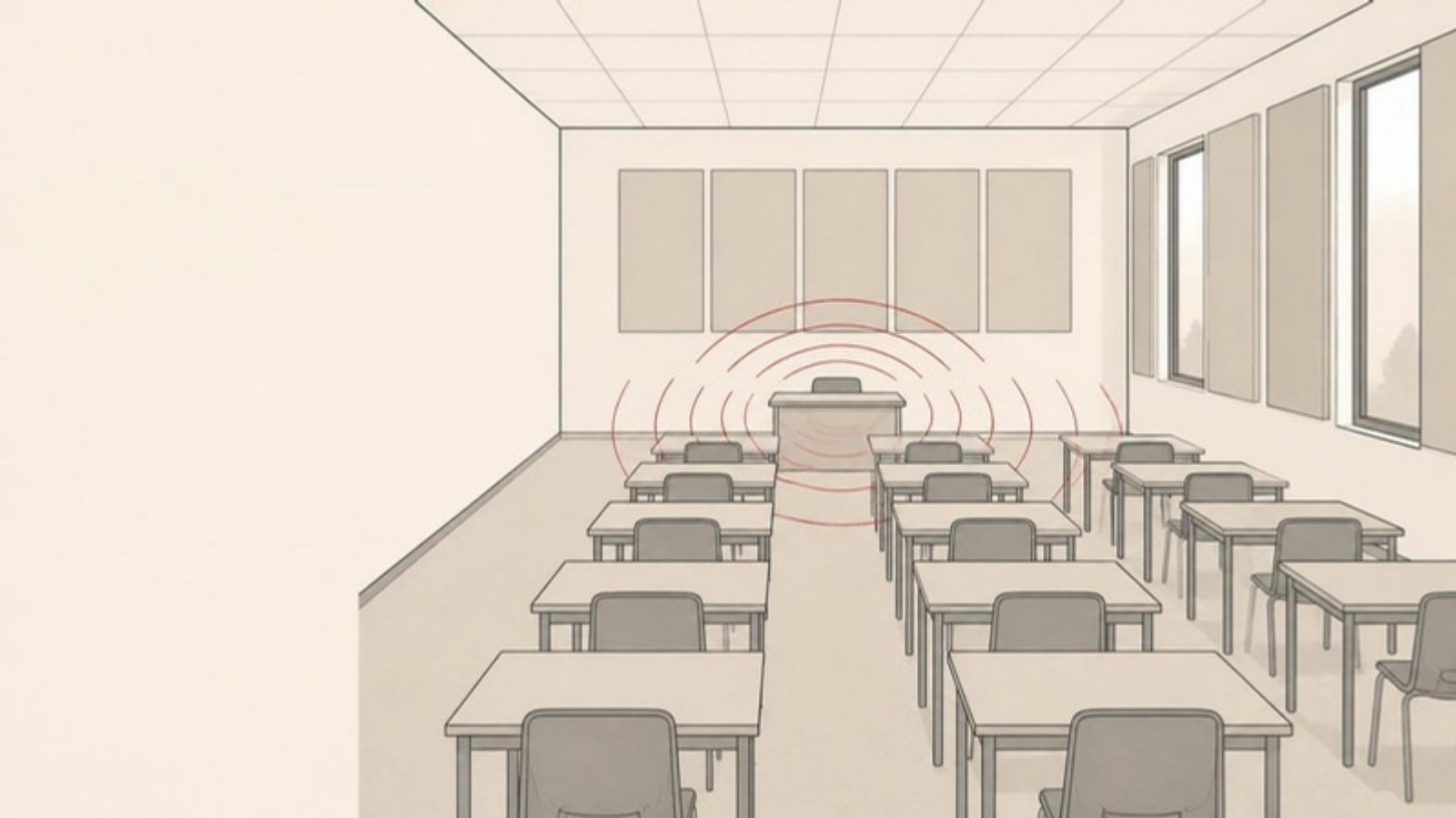
Speech is clear when reverberation is short enough and the talker is sufficiently louder than the background noise — both have to be looked at together. The usual order of treatment is absorption on the ceiling first, then the rear wall, then the upper side walls, and after that the noise sources, such as air-conditioning and sound from neighbouring rooms. Open-plan offices follow the same principles, but the aim is to stop conversation carrying to desks further away.
What makes speech unclear?
Reverberation — in a hard-surfaced room, the sound of one word has not died away before the next arrives. Consonants, which are quiet and short, get masked. See Reverberation and reverberation time.
Background noise — air-conditioners, fans, roads, playgrounds or the room next door. What matters is the difference between the talker's level and the noise (signal-to-noise ratio), which is usually lowest at the back of the room and near noise sources.
The two reinforce each other: a reverberant room also makes the noise linger and build, and when listening is hard, the talker has to push their voice. Teachers working in such rooms every day risk straining their voices.
Who is affected most?
The Acoustical Society of America's Classroom Acoustics booklet names groups that suffer more than others from poor classroom acoustics:
- Young children, who have a smaller vocabulary and less experience than adults for filling in words they miss
- Learners with hearing impairment, who need a larger margin between speech and noise
- Learners taught in a language that is not their first, and learners with learning or auditory-processing difficulties
- Teachers, who have to raise their voices all day
Published reference criteria
| Source | Applies to | Criterion |
|---|---|---|
| --- | --- | --- |
| World Health Organization (WHO), Guidelines for Community Noise (1999) | Classrooms | Background level not above 35 dB LAeq during teaching, and RT about 0.6 s (lower for hearing-impaired children) |
| Acoustical Society of America — Classroom Acoustics (2000) | Classrooms | RT in the range 0.4–0.6 s; the teacher's voice at least 10 dB above the noise (at least 15 dB for children with hearing impairment) |
| WELL Building Standard v1, Feature 78 | Learning spaces | RT below 0.6 s for rooms up to 280 m³, and below 0.7 s for rooms of 280–570 m³ |
| WELL Building Standard v1, Feature 78 | Open workspaces | RT 0.5 s |
These figures are the criteria of each document, not Thai law. If the project has its own requirement, follow that.
Classrooms: order of treatment
- Ceiling — the largest surface and out of children's reach; it usually supplies the most absorption in one step. In some lecture rooms the designer may leave the centre of the ceiling reflective to help carry the teacher's voice to the back
- Rear wall — reduces the teacher's voice bouncing back to the front, which disturbs both the teacher and the front rows
- Upper side walls — if flutter echo remains between parallel walls, fix absorbing panels staggered on the two walls
- Noise sources — air-conditioners, fans, the corridor, neighbouring rooms or outside. Absorption helps only a little here; deal with the equipment, doors, windows or walls
Spreading absorption over several surfaces usually works better than concentrating it on one. Carpet reduces the noise of chairs and desks being moved but does little for reverberation.
Open-plan offices: a different aim
In an open-plan office the main problem is not that speech is unclear, but that other people's conversations are too clear and distracting. ISO 3382-3 therefore assesses how quickly speech level falls with distance, and the distance at which speech intelligibility has dropped to a level that no longer captures attention (the distraction distance).
The usual order:
- An absorbing ceiling over the whole area — reduces sound reflected off the ceiling to distant desks
- Screens and furniture between desks — block the direct sound and make the level fall faster with distance
- Walls and columns — absorption on hard surfaces that reflect sound across the space
- Layout — keep phone areas, huddle spaces and printers away from areas for concentrated work
Absorption reduces reverberation and makes sound fall off faster with distance, but it does not stop the next desk from hearing you. Rooms that need speech privacy must be enclosed rooms designed for sound insulation.
Which materials?
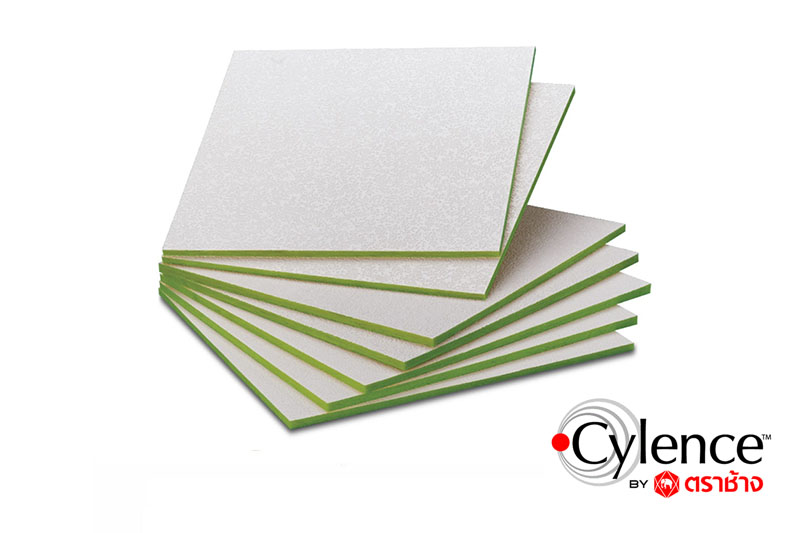
- T-bar grid ceilings — sound-absorbing ceiling tiles such as SCG Cylence Armax, a glass-wool tile with a white vinyl face, 19 and 25 mm thick, for laying into a T-bar grid
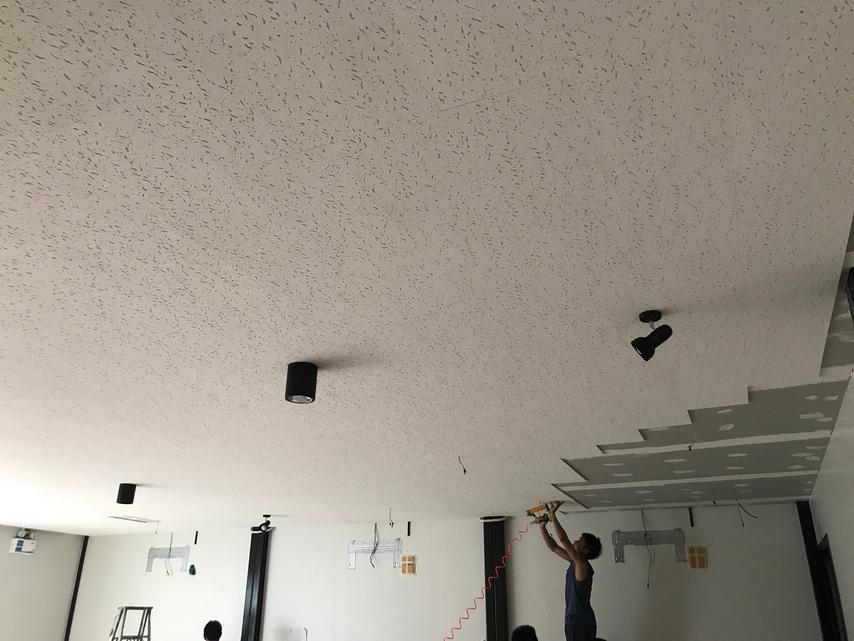
- Existing smooth ceilings — glue-on absorbing boards such as M-Board, a mineral-fibre board 300 × 600 × 12 mm. Its NRC of 0.53 is a Get Best Sound measurement on an unpainted board; do not paint it, because absorption falls
- Rear and side walls — prefabricated absorbing wall panels such as SCG Cylence Zoftone, a glass-wool board faced with glass cloth, fixed with adhesive and pins to brick, concrete or gypsum walls. Its NRC to ASTM C423 is 0.65 at 25 mm (tested on bare glass wool) and 0.85–1.00 at 50 mm depending on the density grade
See Choosing a sound-absorbing ceiling for the ceiling choice and Echoey meeting rooms for estimating quantity. Schools and offices often have fire requirements for interior finishes; check each product's documents.
Absorption does not block sound from next door
If the problem is noise from the adjoining classroom, the corridor or the road, it has to be dealt with at the walls, doors, windows and leaks. See Do sound absorbing panels stop noise leaving a room?
See solution: Echoey rooms
Sources
- Acoustical Society of America, Technical Committee on Architectural Acoustics — Classroom Acoustics: A resource for creating learning environments with desirable listening conditions (2000)
- World Health Organization — Guidelines for Community Noise (1999)
- WELL Building Standard v1 — Feature 78 Reverberation Time
- ISO 3382-3 — Acoustics — Measurement of room acoustic parameters — Part 3: Open plan offices (quantities as described in MathWorks documentation)
- SCG Acoustic catalogue (Cylence Zoftone), SCG Armax product page, M-Board measurement by Get Best Sound
Related products
Categories and example products for this topic
- SCG Cylence Armax — Glass-wool ceiling tile for the T-bar grids common in classrooms and offices.
- SCG Cylence Zoftone — Glass-cloth-faced glass-wool wall panel, 25/50 mm, for rear and side walls.
- M-Board — Glues onto an existing smooth classroom or office ceiling — no removal.
Sound absorption · Glass wool
SCG Cylence Zoftone
- Thickness
- 25–50 mm
- Density
- 32–64 kg/m³
- Sound absorption (NRC)
- up to 1.00