How are pins, adhesive and foil tape used to fix and seal insulation?
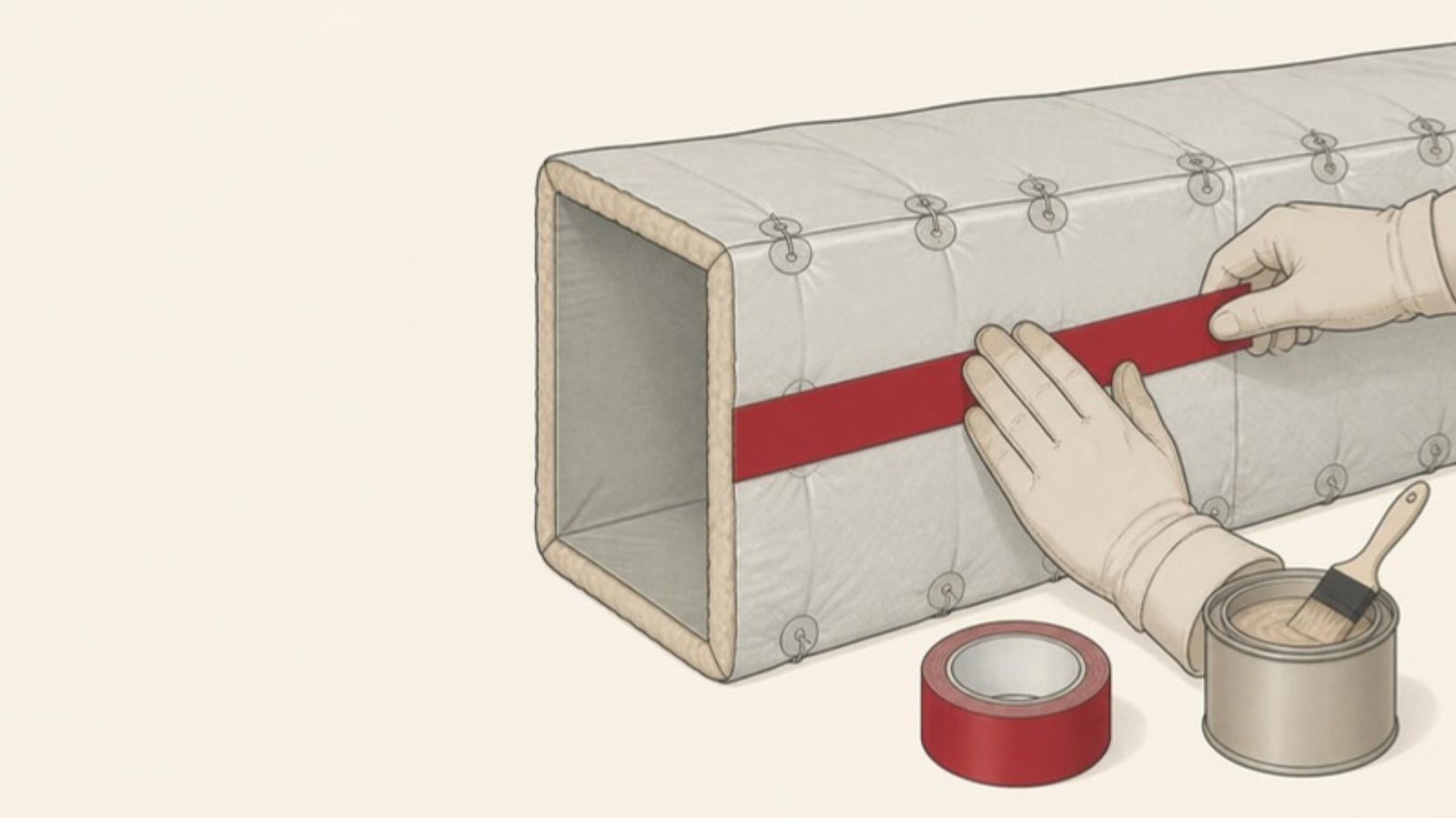
Insulation accessories fall into three groups by function. Pins and washers carry the weight of the insulation so it does not sag or fall. Adhesive holds the insulation against the surface. Aluminium foil tape seals the joints of foil-faced insulation so the vapour-retarding surface is continuous. None of them can do another's job. Each must match the insulation type and the service temperature, and the surface must be dry and clean.
What does each accessory do?
| Accessory | Main job | What it cannot do |
|---|---|---|
| --- | --- | --- |
| Insulation pins and washers | Carry the insulation's weight, especially under ducts and on walls and ceilings | They do not seal joints, and the holes where pins pierce a foil facing must be taped over |
| Insulation adhesive | Holds insulation against the surface and reduces air gaps behind it | Heavy insulation, or insulation facing downward, usually also needs pins to carry the weight |
| Aluminium foil tape | Keeps the joints of a foil facing continuous | It is not designed to carry the insulation's weight |
| Wire, bands, mesh | Hold pipe and equipment insulation in place | They do not stop water vapour or rain |
Which goes with which insulation?
| Job | Accessories commonly used |
|---|---|
| --- | --- |
| Foil-faced glass wool or stone wool on AC ducts | Adhesive suited to the duct surface + pins and washers on the underside and on large ducts + foil tape on every joint and over the washers |
| Sound-insulating or sound-absorbing boards on walls, ceilings and roofs | Pins bonded with construction adhesive, then the board is pushed on and locked with washers |
| Closed-cell elastomeric insulation on pipes | That manufacturer's elastomeric adhesive and tape, applied at every seam |
| Pipe sections and wired mats for hot work | Wire or bands, then metal cladding |
| Hot exhaust and kitchen ducts | Welded pins and metal jacketing as drawn. See Kitchen exhaust duct insulation |
Insulation pins and washers
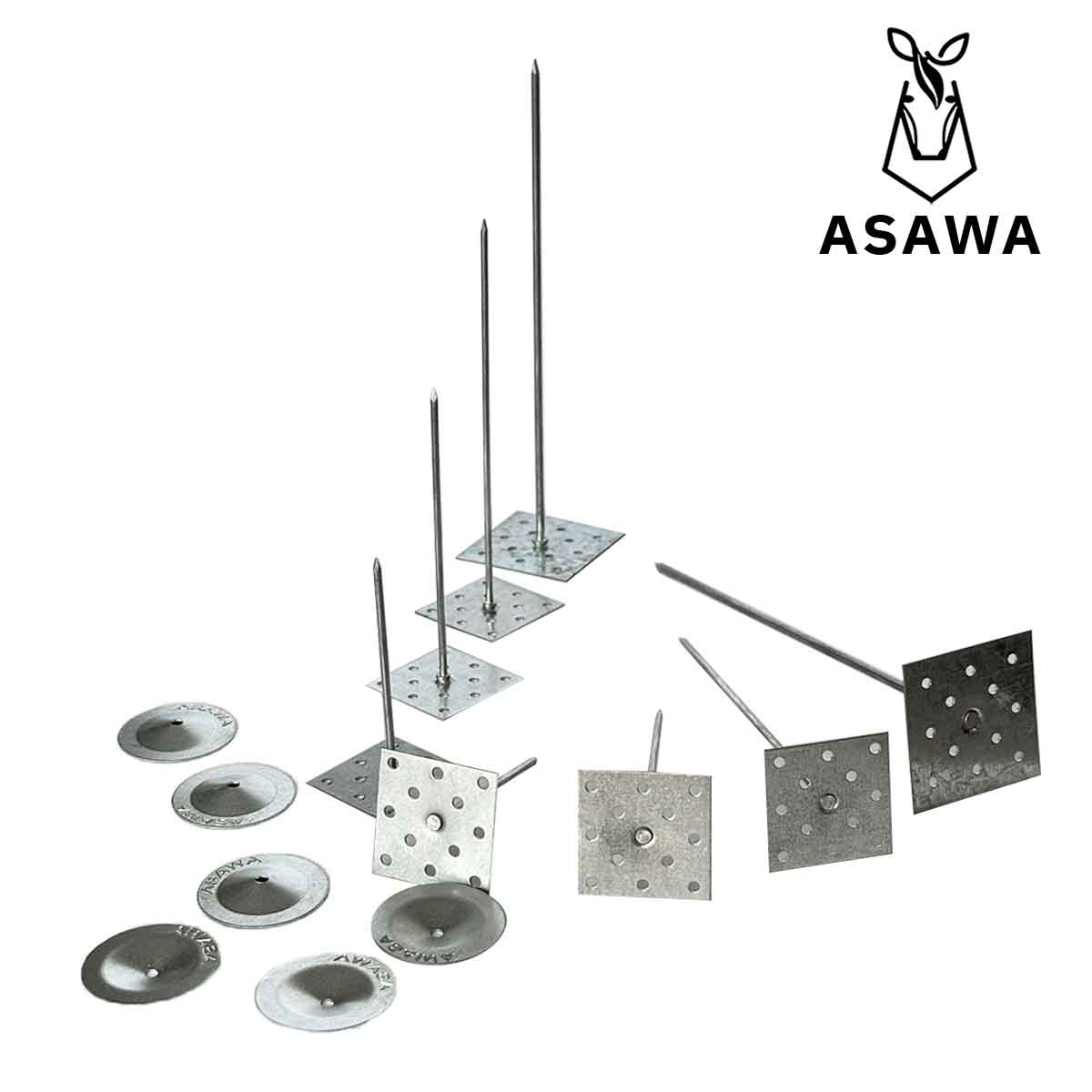
Pins differ in how they attach to the surface: adhesive-bonded, self-adhesive and welded. ASAWA PIN is bonded with construction adhesive. It has an aluminium shank and a galvanised-steel base perforated so that adhesive squeezes up through the holes and grips the face of the base, and it comes in lengths of 32–125 mm.
- Choose the length to suit the insulation thickness. The shank must be long enough to pass through the insulation and take the washer without crushing the insulation.
- Spread adhesive over the whole base, then press until adhesive comes through the holes, as shown in the catalogue, and let the adhesive cure as its manufacturer specifies before pushing the insulation on.
- Cut off the excess shank after fitting the washer, for safety and so that tape can be applied over it.
The number of pins depends on the size and weight of the insulation, its position (wall, ceiling or underside of a duct) and the surface. A ROCKWOOL installation guide gives the same principle: fixing centres depend on the duct size and the weight of the insulation. So there is no single number for every job. The ASAWA PIN catalogue has a table of pin rows by board size for sound-insulating and sound-absorbing boards; for example, it shows 2 rows × 4 rows for a 600 × 1,200 mm board. Use it as a starting point for that kind of work, then adjust to the drawings and the real insulation weight.
On hot surfaces, check the limits of the pin and the adhesive
The ROCKWOOL guide states that the duct surface temperature must not exceed the service temperature of adhesive stick pins. Hot ducts therefore usually use welded pins as the designer specifies. Do not use adhesive-bonded pins on a hot surface without checking the adhesive and pin data.
Insulation adhesive
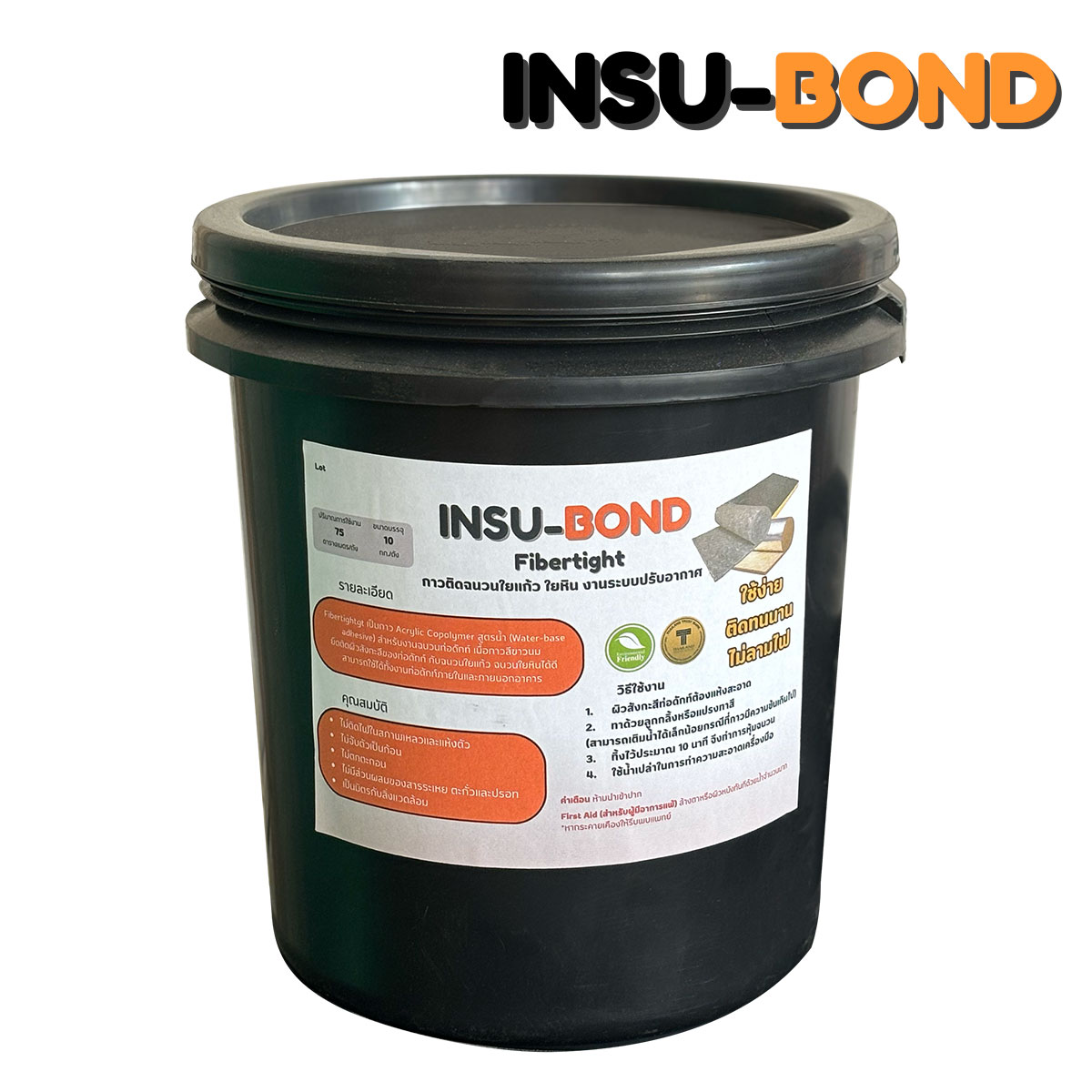
The adhesive must be compatible with both the insulation and the surface. INSU-BOND FiberTight is a water-based adhesive for bonding glass wool and stone wool to galvanised duct surfaces. According to its data sheet:
- The galvanised duct surface must be dry and clean
- Apply by roller or brush, leave for about 10 minutes, then apply the insulation
- The adhesive's operating temperature is -15 to +90 °C
- Coverage is about 7.5 m²/kg when glued on both sides
Closed-cell elastomeric insulation uses a different type of adhesive specified by the elastomeric manufacturer; the two are not interchangeable. Insulation adhesive also does not seal leaks in the duct itself. Duct joints must be sealed properly before insulating.
Aluminium foil tape
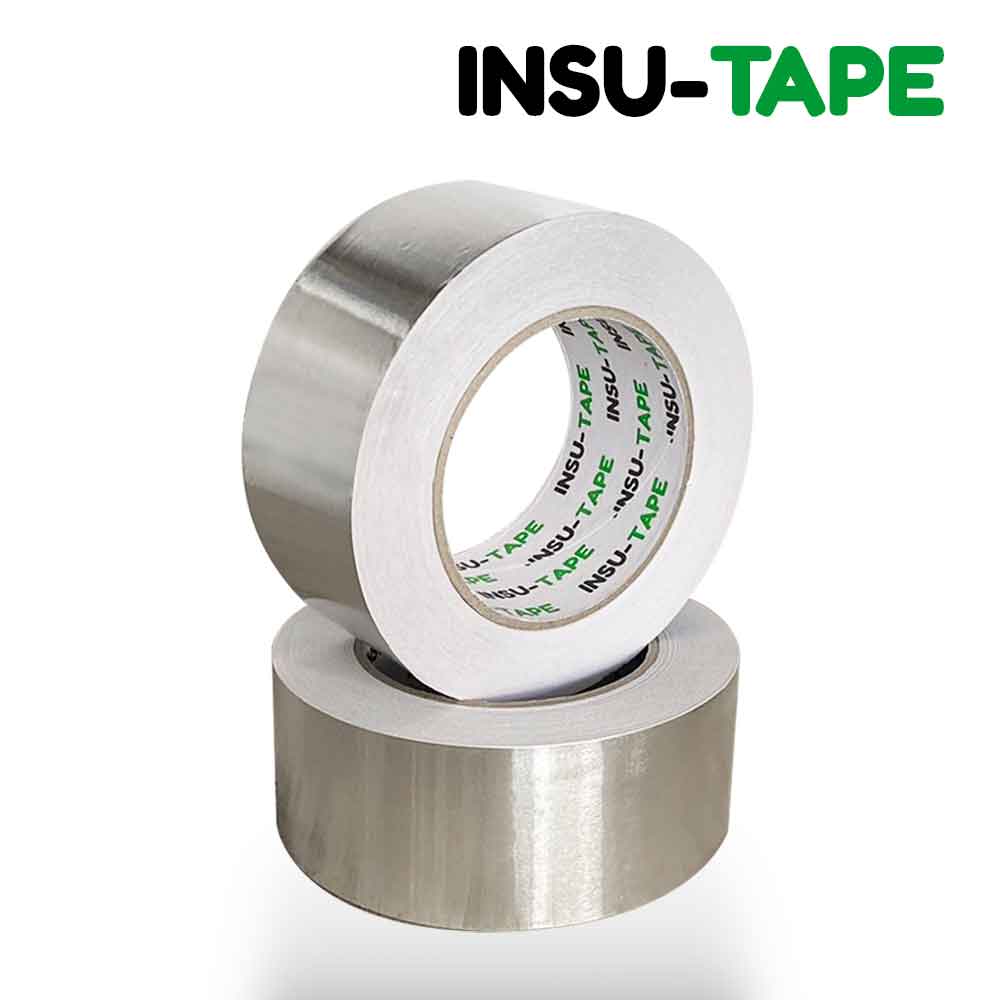
Foil-faced insulation on cold ducts relies on the foil facing as the vapour retarder, so every joint must be taped to keep the surface continuous. See why in What is a vapour barrier? INSU-TAPE is an aluminium foil tape with acrylic adhesive, 50 and 63 mm wide. According to its data sheet:
- The surface must be dry, clean and free of dust, oil and rust
- After applying, press the tape down and smooth out the air so it bonds along its whole length
- Application temperature is 10–40 °C, and heat resistance in service is -20 to 120 °C
- Tape over pin washers and tears in the foil as well. The ROCKWOOL guide says to seal with foil tape wherever pins or hangers puncture the foil, to maintain the vapour barrier
Foil tape is for foil facings. It is not the way to seal elastomeric insulation seams. See Sealing insulation joints.
Preparing the surface
- Wipe dust, oil and moisture off the duct, wall or foil surface.
- If a cold duct is in operation and sweating, dry the surface first. Adhesive and tape do not bond to a wet surface.
- Check that the surface and air temperature are within the range given in the adhesive and tape documents.
- Try a small area first when the surface is a material you have not used the product on before.
Common failures
- Joints not taped, or not taped along their full length: water vapour gets in and condenses in the insulation on cold ducts
- Pin washers not taped over: every point where a pin pierces the foil is a path for water vapour
- Too few pins, or pins bonded to a dirty surface: insulation under the duct sags and gaps open
- Washers or bands pulled so tight that the insulation is crushed: thickness is lost at that point. See Gaps and compression in insulation
- Tape applied to a dusty or wet surface: the tape peels later
- Adhesive or tape used beyond its temperature range, for example on a surface hotter than its document allows
Sources
- ASAWA PIN catalogue (technical data, method of use and board installation table)
- 3T Insulation — INSU-BOND FiberTight data sheet
- 3T Insulation — INSU-TAPE Aluminium Tape data sheet
- ROCKWOOL Limited (UK) — Installation guide: Ductwrap and Ductslab (22/2/2021)
- ROCKWOOL (Thailand) — Handout: ROCKWOOL insulation for HVAC ducts, 200 602-9/25 V8 (TH)
Related products
Categories and example products for this topic
- ASAWA PIN — Aluminium pin on a GI steel base, bonded with adhesive, 32–125 mm long.
- INSU-BOND FiberTight — Water-based adhesive for glass/stone wool on galvanised ducts, -15 to +90 °C.
- INSU-TAPE Aluminium Tape — Acrylic-adhesive foil tape for foil-faced insulation joints, 50 and 63 mm.
Installation accessories · Adhesive
3T INSU-BOND FiberTight
- Service temp.
- -15 – 90 °C
- Coverage
- 7.5 m²/kg
- Pack
- 10 kg
Installation accessories · Tape
3T INSU-TAPE Aluminium Tape
- Width
- 50 / 63 mm
- Length
- 45 m
- Service temp.
- -20 – 120 °C