5 min read · Written by our team · Updated 26 Sept 2026
In short
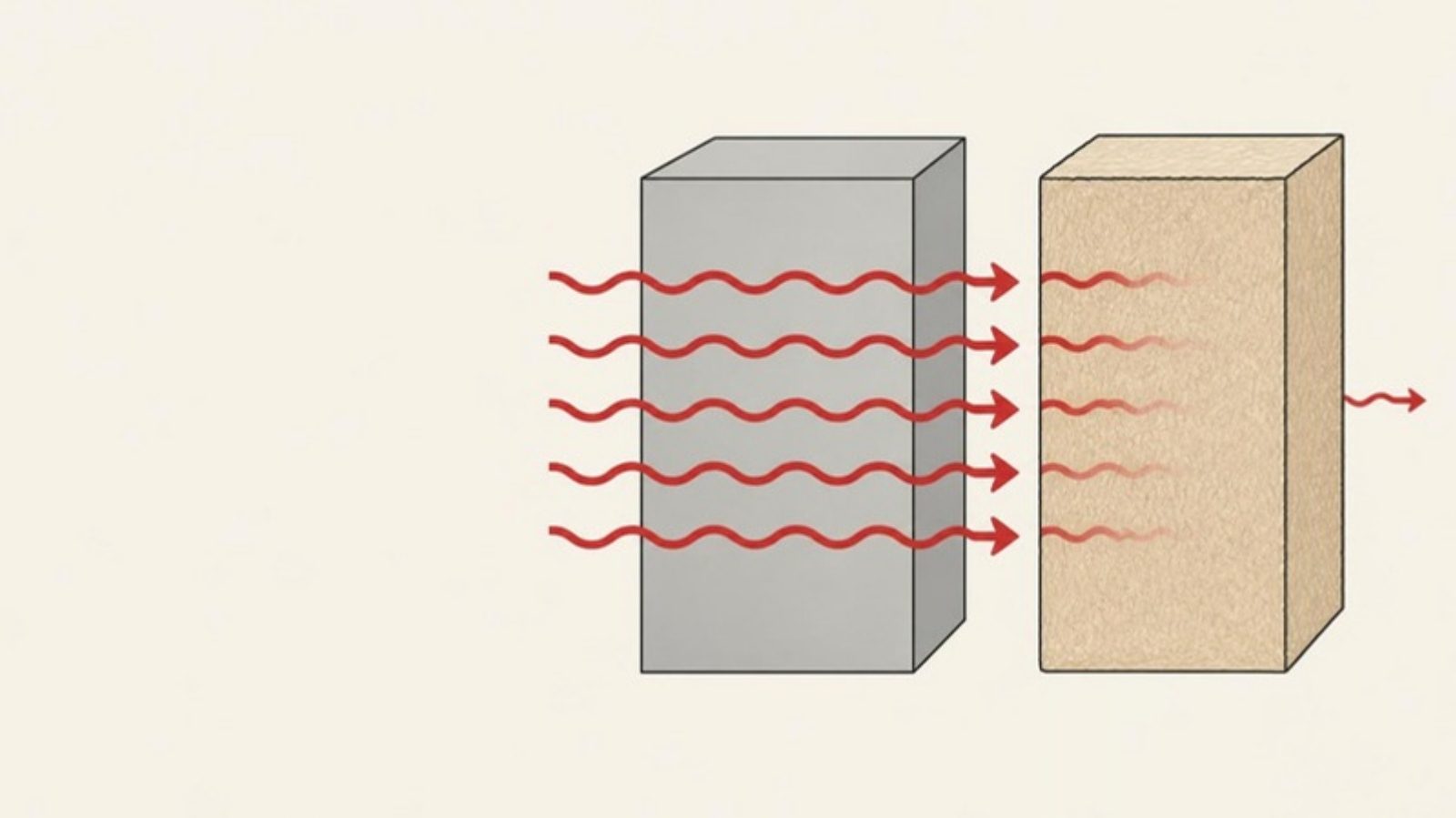
Thermal conductivity, written λ (lambda) or k-value, is a property of a material that shows how easily heat passes through it. Its unit is W/m·K. For insulation, the lower the value, the less heat it conducts. But λ describes only the material itself; real performance also depends on thickness (the R-value) and on how the whole system is installed.
1λ (thermal conductivity, W/m·K): a property of the material; lower means less heat conducted — independent of thickness
2R (thermal resistance, m²·K/W): for a layer of given thickness, R = thickness ÷ λ; the same material in a thicker layer gives a higher R
3U (W/m²·K): the heat transfer rate through a whole wall or roof, all layers and surface air films included; lower means less heat passes
What does λ tell you?
λ is the amount of heat that flows through 1 metre of material over 1 square metre when the two sides differ by 1 degree (kelvin or Celsius, the difference is the same), under steady conditions. It lets you compare materials to see which conducts more heat and which less.
SI unit: W/m·K (also written W/(m·K) or W/mK)
US documents may use Btu·in/(h·ft²·°F), a different unit that must be converted before comparing (1 Btu·in/(h·ft²·°F) ≈ 0.144 W/m·K)
Names you will see: thermal conductivity, λ, k, k-value
Why is lower better — but not the whole story?
A lower λ means that at the same thickness the material lets less heat through. In practice, insulation is not always used at the same thickness. The thermal resistance of an insulation layer is thickness ÷ λ, so a product with a lower λ used thinner can resist heat less than one with a higher λ used thicker.
Hypothetical example
λ (W/m·K)
Thickness
R = thickness ÷ λ (m²·K/W)
---
---
---
---
Material A
0.040
50 mm (0.050 m)
1.25
Material B
0.032
25 mm (0.025 m)
0.78
This hypothetical example only explains the method and is not data for any product: material B has the lower λ, but used thinner, the layer of A resists more heat.
How to read λ on a datasheet
Check the mean temperature of the test — the λ of insulation changes with temperature. A good datasheet states the mean temperature. Compare products at the same mean temperature, especially for very hot or very cold work; manufacturers often give a table or curve over several temperatures.
Check the density or grade tested — for fibrous insulation, λ depends on density, fibre diameter and how even the material is, so the value of one grade does not apply to another.
Check the test standard — e.g. ASTM C518 or ISO 8301 (heat flow meter), ASTM C177 or ISO 8302 (guarded hot plate).
Match the units — do not compare a W/m·K figure directly with an imperial one.
Datasheet λ is a laboratory value
It is measured on a clean, dry, uncompressed specimen. On site, insulation that is compressed, does not cover the whole area or has gaps performs below what the datasheet figure suggests.
Using λ to choose insulation
Use λ to shortlist materials, compared at the same mean temperature.
Calculate or look up the R-value at the thickness you will actually use, and compare by R.
For the λ of a specific product, see the manufacturer's datasheet or ask us. To compare glass wool and stone wool, read stone wool vs glass wool. Browse thermal insulation.
Sources
ISO 7345:2018 — Thermal performance of buildings and building components — Physical quantities and definitions
ASTM C168 — Standard Terminology Relating to Thermal Insulation
ASTM C518 — Steady-State Thermal Transmission Properties by Means of the Heat Flow Meter Apparatus
ASTM C177 — Steady-State Heat Flux Measurements and Thermal Transmission Properties by Means of the Guarded-Hot-Plate Apparatus
ISO 8301 / ISO 8302 — Thermal insulation — Determination of steady-state thermal resistance and related properties (heat flow meter / guarded hot plate)
ASTM C1045 — Standard Practice for Calculating Thermal Transmission Properties Under Steady-State Conditions (λ as a function of temperature)
ASTM C680 — Standard Practice for Estimate of the Heat Gain or Loss and the Surface Temperatures of Insulated Flat, Cylindrical, and Spherical Systems
Check the message below, then press “Open LINE”. On a phone LINE opens with this message; on a computer LINE shows a QR code to scan with your phone. If LINE does not open, copy the message into the chat, or call us.